
If you’ve taken the CELPIP test and feel that your scores don’t reflect your true abilities, you may be wondering if you can request a re-evaluation. Fortunately, CELPIP offers a re-evaluation process to give test-takers the opportunity to have their scores reviewed. This process ensures fairness and accuracy in language assessments, providing a safety net in cases where scores seem inconsistent or where issues may have affected the test.
In this article, we’ll explain the CELPIP re-evaluation process, including eligibility, how to apply, associated fees, processing time, and potential outcomes. Let’s dive into the details to help you decide if a re-evaluation is the right choice for you.
What is CELPIP?
Before we discuss re-evaluation, it’s important to understand what CELPIP is. The Canadian English Language Proficiency Index Program (CELPIP) is an English proficiency test widely used for immigration, citizenship, and employment purposes in Canada. It tests four key language skills:
Listening
Reading
Writing
Speaking
CELPIP is unique because it’s completely computer-based, which means the Listening and Reading sections are scored by advanced algorithms, while the Speaking and Writing sections are scored by human raters. This mix of technology and human judgment can sometimes lead to discrepancies, which is where the re-evaluation process comes in.
Why Do You Need a Re-Evaluation?
There are several reasons why someone might feel their CELPIP results don’t accurately reflect their performance. Some common reasons include:
Inconsistent Scores: When practice test scores do not match official test results, test-takers may feel there’s an issue with the evaluation.
Subjective Scoring: Discrepancies in the Speaking or Writing sections, where human raters assess the work, can feel unfair if the feedback seems inconsistent or inaccurate.
Technical Problems: Issues like audio playback problems during the Listening section may lead test-takers to question their results.
The re-evaluation process allows you to have these concerns addressed without retaking the entire test, which could be costly and time-consuming.
What Is the Re-Evaluation Process?
The re-evaluation process gives test-takers the chance to request a second look at their results to ensure they’re fair and accurate.
Review: A team of raters or technical staff will review the test results and scoring.
Focus: Only specific sections can be reviewed, or you can ask for a full re-evaluation of the test.
Digital Submissions: The process has been made easier with online submissions, speeding up the review process.
Who is Eligible for a Re-Evaluation?
Not everyone is eligible to request a re-evaluation, and there are specific guidelines that must be followed:
Time Frame: You must request a re-evaluation within six months of the original test date. This ensures that the test materials and recordings are still accessible for review.
Test Version: The re-evaluation process is available for the CELPIP-General Test, which is used for immigration purposes. Other versions like CELPIP-General LS may have similar rules, but this article focuses on the standard test.
Re-Evaluation Limit: Each section of the test can only be re-evaluated once. If you’re not satisfied with the outcome of the re-evaluation, you cannot request a second review for the same section.
Multiple Sections: You can request re-evaluation for one section, multiple sections, or the entire test, depending on your concerns.
What Parts of the Test Can Be Re-Evaluated?
Not all parts of the test are equally likely to change after re-evaluation. Here’s what you can expect:
Speaking & Writing:
These sections are scored by human raters, so they’re more likely to show changes after re-evaluation.
You can request a review of either or both of these sections if you feel the scores don’t reflect your true performance.
Listening & Reading:
These sections are scored by automated systems, making them more consistent.
Changes to these sections are less likely unless there were technical issues during the test.
How to Apply for a Re-Evaluation
The process for requesting a re-evaluation is straightforward. Here’s how you can apply:
Submit Your Request:
Requests must be made within six months of your test date.
Use the online application system to submit your re-evaluation request.
Choose Sections to Review:
You can request a review of the full test or specific sections (Speaking, Writing, Listening, or Reading).
Pay the Fee:
There is a fee for the re-evaluation process. The exact amount may vary, so it’s important to check the current rates on the CELPIP website.
Wait for Results:
After your request is submitted, the re-evaluation team will review your test and scores. The time it takes to process can vary but is usually faster with the online system.
Costs and Fees for Re-Evaluation
There is a fee associated with the re-evaluation process. The cost may vary, so it’s important to check the latest rates on the CELPIP website. The fee generally covers the cost of re-assessing the test and handling the process digitally.
Fees: Expect to pay for the re-evaluation, but you will only pay for the sections you request to be reviewed. If you only want one section reviewed, the cost will be lower than requesting a review of the entire test.
How Long Does the Re-Evaluation Take?
The re-evaluation process is quicker now, thanks to the online application system. Typically, it can take several weeks to process the re-evaluation request, but this is faster than traditional paper-based methods.
Faster Processing: Online systems reduce paperwork and speed up communication, allowing for quicker responses.
Possible Outcomes of Re-Evaluation
After the re-evaluation, there are a few possible outcomes:
No Change:
In many cases, the re-evaluation process confirms that the original scores are accurate. In this case, the scores will remain the same.
Score Change:
If the re-evaluation team finds discrepancies or errors, your scores may be adjusted, potentially resulting in a higher score.
Partial Review:
In some cases, only specific sections may change if the review shows inconsistencies in scoring.
Important Considerations for Re-Evaluation
Realistic Expectations:
Understand that re-evaluation doesn’t always result in a change of scores. It’s meant to ensure accuracy, not to improve scores artificially.
No Retake Option:
Re-evaluation isn’t a shortcut to improving your score. If you want to retake the test, you will need to register for a new test session.
One Review per Section:
Once you request a re-evaluation for a section, it cannot be reviewed again.
Conclusion
The CELPIP re-evaluation process offers a way for test-takers to ensure their results are fair and accurate. If you believe that there was a mistake in scoring, or if technical issues affected your test, this process allows you to request a second review of your scores.
Remember, re-evaluation is only for addressing discrepancies, not for improving your score.
Be sure to make your request within six months of the original test date, and choose which sections you want reviewed carefully.
Understand that while re-evaluation can lead to score changes, it’s not always guaranteed.
By understanding the re-evaluation process, you can make informed decisions about how to proceed and ensure that your CELPIP scores accurately reflect your language proficiency.
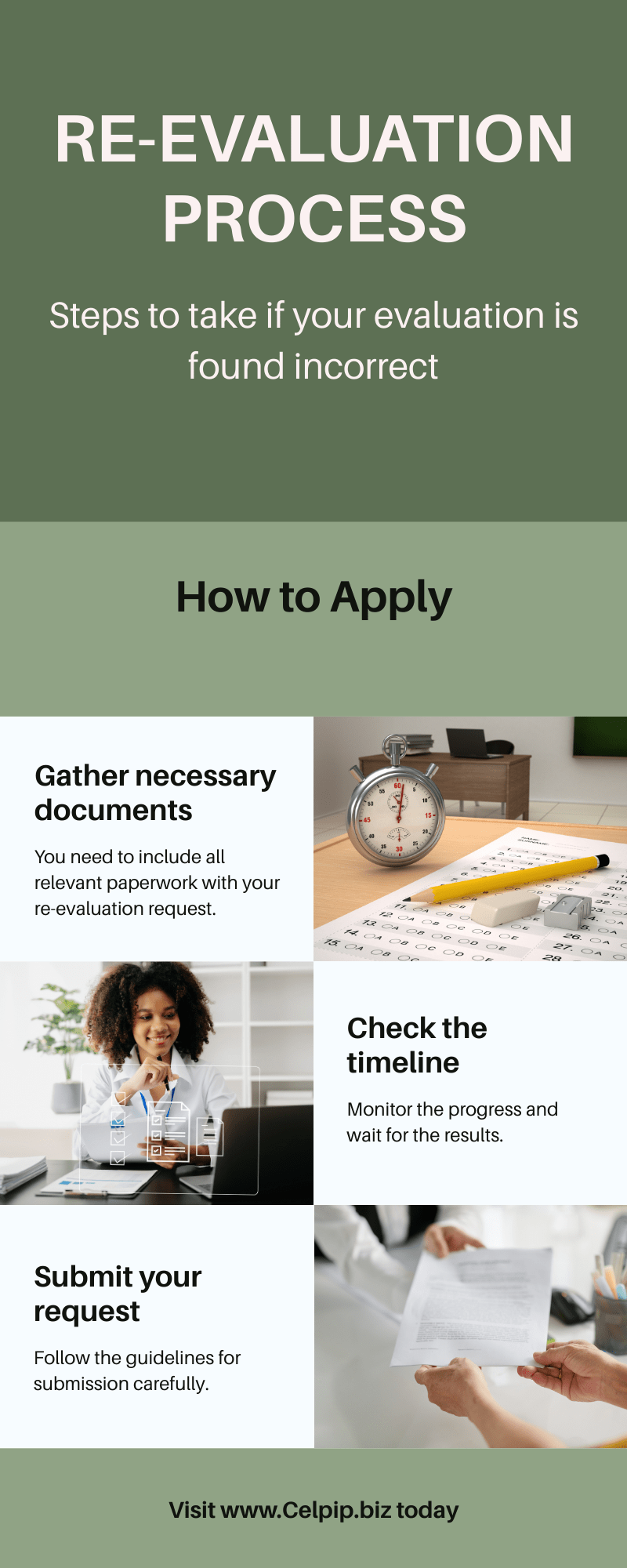
Step-by-Step Guide to Applying for Re-Evaluation
The application process for CELPIP re-evaluation has been updated to be primarily online, making it straightforward and accessible. Here’s a detailed breakdown of the steps, based on the latest procedures:
- Access Your Account: Begin by signing into your CELPIP account. This is the central hub where you manage all test-related activities, including viewing scores and submitting requests. If you don’t have an account or have forgotten your login details, recovery options are available through the system’s support features.
- Locate the Re-Evaluation Option: Once logged in, navigate to the section dedicated to test results or post-test services. There, you’ll find the option to request a re-evaluation. Select the components you wish to have reviewed—Listening, Reading, Writing, Speaking, or all of them.
- Complete the Application: Fill out the required details, which typically include your test date, test center location (if applicable), and a brief explanation of why you’re requesting the re-evaluation. While a detailed justification isn’t always mandatory, providing one can help the reviewers understand your concerns.
- Pay the Required Fee: At this stage, you’ll be prompted to pay the re-evaluation fee. The fee varies depending on the number and type of components selected. For example, re-evaluating a single component might cost less than reviewing the entire test. Payment is made securely online, and it’s essential to complete this step for your request to be processed.
- Submit and Confirm: Review all information for accuracy, then submit the request. You’ll receive a confirmation, and the process begins. Remember, submissions are final, with no option for cancellation.
- Await Notification: After submission, the review team will examine your test materials. This includes re-rating by additional certified raters for human-scored sections or verifying algorithms for automated ones.
These steps, as outlined in CELPIP.BIZ resources, ensure a smooth experience. Compared to older methods that might have involved emailing customer service or mailing forms, the online system represents a significant update, reducing errors and speeding up the process.
Fees Associated with Re-Evaluation
One of the key considerations for test-takers is the cost of re-evaluation. The fee is not a flat rate but depends on the components chosen for review. For instance, requesting a re-evaluation of just the Writing component would incur a lower fee than opting for all four.
While exact amounts can fluctuate and should be confirmed during the application, they are designed to cover the administrative and rating costs involved.
A notable feature of the fee structure is the refund policy: if your score level changes as a result of the re-evaluation for any component, the fee for that specific component will be fully refunded.
This incentive encourages legitimate requests and provides some financial relief if an error is indeed found. However, if no changes occur, the fee is non-refundable, underscoring the importance of only applying when you have strong grounds for belief in an inaccuracy.
In comparison to retaking the test, which involves full registration fees (often several hundred dollars), re-evaluation is generally more affordable. Updates to the fee system ensure transparency, with all costs displayed upfront during the online application.
Processing Timelines and Receiving Results
Patience is key when waiting for re-evaluation outcomes. The latest timelines indicate that you will be notified of the results approximately one to two weeks after submitting your application and payment. This is a marked improvement from earlier processes that could take several weeks, thanks to digital efficiencies.
During this period, your original scores remain valid and can be used for applications if needed. Once the review is complete, you’ll receive an updated notification via your account or email. If changes are made, a new score report will be issued, reflecting the revised levels. This report can then be submitted to IRCC or other organizations as needed.
It’s important to note that while the process is expedited, peak periods might extend timelines slightly. Planning accordingly, especially if you have deadlines for immigration applications, is advisable.
Possible Outcomes and What They Mean
The outcomes of a re-evaluation can vary. In the best-case scenario, your scores increase, validating your concerns and potentially opening doors to higher language proficiency benchmarks for your goals. If a change occurs, you’ll receive the refund for the affected component’s fee, and the new scores become official.
However, it’s equally possible that scores remain unchanged. This is particularly true for computer-scored sections, where re-evaluation rarely results in adjustments due to the reliability of the algorithms. In such cases, the original scores stand, and no refund is issued. A less common outcome is a score decrease, though this is rare as re-evaluations focus on verifying accuracy rather than penalizing.
Regardless of the result, the process provides closure and reassurance about the fairness of the scoring. As highlighted in CELPIP.BIZ, understanding that re-evaluation isn’t a guarantee of change helps manage expectations.
Tips for a Successful Re-Evaluation Request
To maximize the chances of a positive outcome, consider these tips:
- Gather Evidence: Before applying, review your test performance. For Speaking or Writing, recall specific responses that might have been underrated.
- Choose Components Wisely: Focus on areas where human judgment plays a role, as automated sections are less likely to change.
- Act Promptly: Don’t wait until the end of the six-month window, as materials might be archived.
- Prepare for No Change: Have a backup plan, such as retaking the test, if needed.
- Seek Advice: Consult preparation resources or forums (without relying on unofficial advice) to gauge if your case is strong.
Integrating these strategies can enhance your approach.
Common Myths and Misconceptions About Re-Evaluation
There are several myths surrounding CELPIP re-evaluation. One common belief is that it’s equivalent to retaking the test—it’s not; it’s a review, not a new assessment. Another myth is that scores are deliberately lowered to encourage re-evaluations for revenue, which has been debunked in official discussions. Updates clarify that scoring is independent and fair.
Additionally, some think re-evaluation is free or always results in higher scores—neither is true. By dispelling these, test-takers can approach the process realistically.
How Re-Evaluation Fits into Overall Test Preparation
Re-evaluation should be seen as a last resort, not a primary strategy. Effective preparation through practice tests, study materials, and understanding the test format can minimize the need for it. Resources like those on CELPIP.BIZ offer practice exams that mirror the real test, helping build confidence.
If re-evaluation is pursued, it can inform future preparations by highlighting weaknesses. Ultimately, it’s part of a broader ecosystem ensuring CELPIP remains a trusted measure of English proficiency.
In summary, if you believe your CELPIP evaluation is incorrect, applying for re-evaluation is a viable option within six months of your test date. The process involves online submission, payment of component-based fees, and waiting one to two weeks for results, with potential refunds if scores change.
While not guaranteeing adjustments, it upholds the test’s integrity. By following the steps outlined and managing expectations, you can navigate this effectively. For more insights, exploring reliable sources like CELPIP.BIZ can provide additional guidance on test-related topics.