You are currently viewing Understanding Celpip Scoring Levels

Understanding Celpip Scoring Levels

Canadian English Language Proficiency Index Program (CELPIP), is a recognized test which helps in evaluating English skills in Listening, Wring, Reading and Speaking.

As of 2025 updates, the CELPIP test is a key tool for those individuals who want to achieve Professional Designation, Canadian Citizenship and Permanent Residency. This article helps you to explore thoroughly about required Celpip Scores for CELPIP test, explaining how test-takers can interpret their results, what each level represents and how scores are determined to meet their goals. 

By understanding these scoring levels, candidates can better prepare and target the proficiency required for their specific needs, such as permanent residency applications under programs like Express Entry or the Federal Skilled Worker Program.

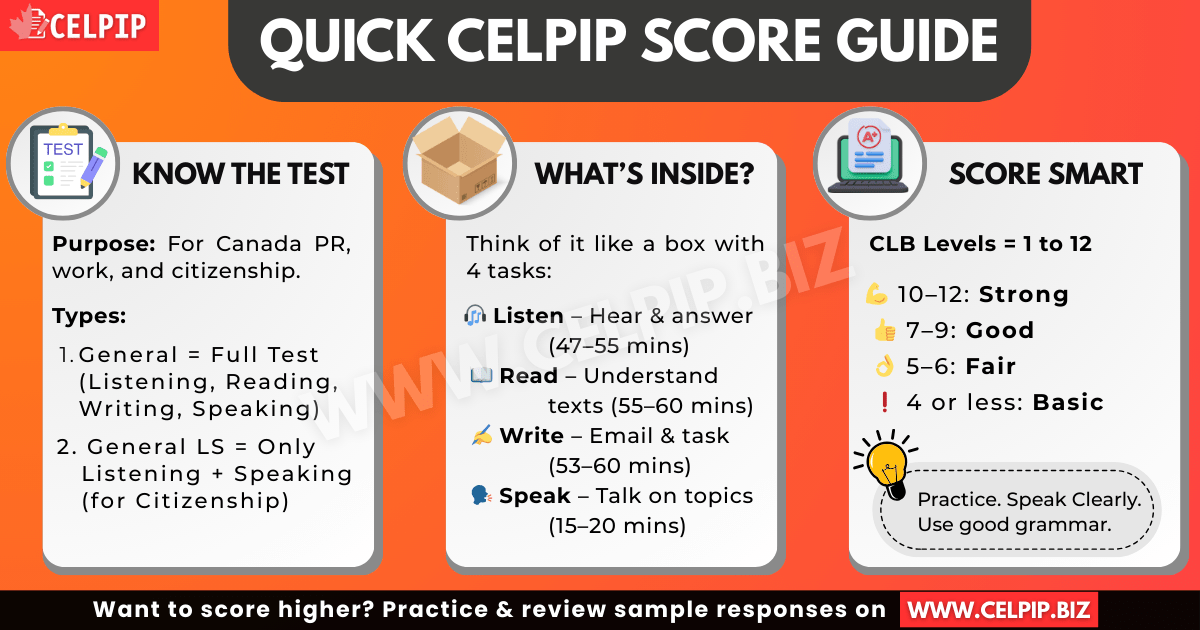
The CELPIP test is fully computer-delivered, making it convenient and efficient for test-takers worldwide. It comes in two main versions: the CELPIP-General, which evaluates all four language skills, and the CELPIP-General LS, which focuses solely on listening and speaking. 

The scoring system is aligned with the Canadian Language Benchmarks (CLB), ensuring that results are directly applicable to immigration requirements set by Immigration, Refugees and Citizenship Canada (IRCC). Scores ranging from 0-2 to 12, with higher levels indicates greater proficiency level. 

According to the latest updates,  the lower score level has been given as “M” (minimal) designation with a clear range from 0-2 range to reflect better proficiency. This change was applied in late 2023 and now has been confirmed in 2025 which allows for the finer variations in basic Language Skills.

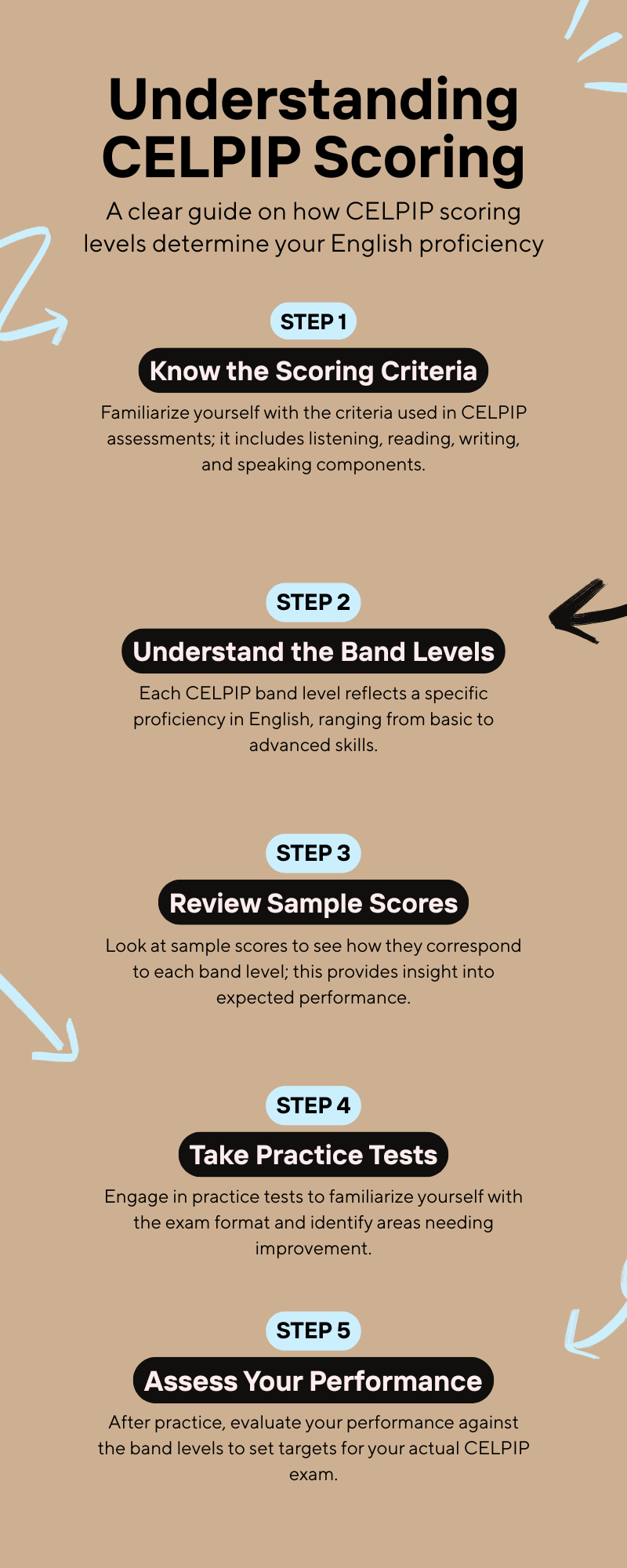
In this blog, we will study the overall scoring criteria, which is followed by breakdowns of every levels for each skill section.

Whether you are a beginner who aim for proficiency basic daily life proficiency or an experienced user whose target is to grasp these levels or targeting excellence in workplace. CELPIP.BIZ focuses on familiarity with the test format and consistent practice, which are basic keys to achieve targeted scores.

Overview of CELPIP Scoring System

The CELPIP scoring system is designed to be fair, reliable, and reflective of real-world English usage in Canadian contexts. Each skill—listening, reading, writing, and speaking—is scored independently on a scale from 0-2 to 12. The overall score is an average of the four skills for the CELPIP-General test, while the LS version provides separate scores for listening and speaking.

For listening and reading, scores are based on the number of correct answers. These sections are objective, with multiple-choice questions, and raw scores are converted to CELPIP levels using a predetermined mapping. 

For instance, in listening, there are 38 scored items across six parts, and in reading, also 38 items across four parts. The conversion ensures that even partial credit isn’t given; it’s all or nothing per question.

Writing and speaking, however, are subjective and rated by trained evaluators using four dimensions: Content/Coherence, Vocabulary Range, Readability/Listenability, and Task Fulfillment. 

Test results are available online within 3-4 business days, and official score reports include breakdowns by skill, helping candidates identify strengths and weaknesses.

CELPIP.BIZ notes that scores are valid for two years, and retakes are allowed after 30 days. Understanding the Celpip Levels helps in achieving targets; for example, For Express Entry Program, a candidates need to score at least level 7 in each skill to achieve maximum Comprehensive Ranking System (CRS) points.

Listening Scoring Levels

The Celpip Listening Module Tests comprises of everyday scenarios, such as discussions, news items, and conversations. It lasts about 47-55 minutes and includes parts like Problem Solving, Daily Life Conversation, Information, News Item, Discussion, and Viewpoints. With 38 questions, scores are mapped as follows (approximate raw score ranges based on latest calibrations):

  • Level 12: 35-38 correct – Advanced proficiency, understanding complex, abstract discussions with nuance.
  • Level 11: 33-35 correct – Highly effective, grasping detailed information in fast-paced dialogues.
  • Level 10: 31-33 correct – Effective proficiency, comprehending main ideas and inferences in workplace contexts.
  • Level 9: 28-31 correct – Good proficiency, following prolonged talks with some cultural and idioms references.
  • Level 8: 25-28 correct – enough for community interactions like social exchanges.
  • Level 7: 22-25 correct – Developing proficiency in routine conversations.
  • Level 6: 19-22 correct – Acquiring skills, knowing simple and basic instructions narratives.
  • Level 5: 16-19 correct – Adequate for understanding short and clear messages, daily activities.
  • Level 4: 10-16 correct – Some proficiency in limited contexts.
  • Level 3: 7-10 correct – Initial proficiency, identifying basic words in slow speech.
  • Level 0-2: 0-7 correct – Limited ability, understanding  isolated phrases or words.

At higher levels (9-12), listeners can handle demanding situations like debates or lectures, inferring unspoken meanings and noting tone variations. For example, in a viewpoints part, a level 10 listener would accurately identify biases in opinions expressed.

Mid-levels (5-8) focus on practical comprehension, such as following directions or understanding announcements. Level 7 might miss underlying messages but understand overall purpose.

Lower levels (0-2 to 4) indicate challenges with understanding vocabulary or speed which is the basic needs like greetings.

CELPIP.BIZ suggests practicing with audio materials, with timely response and noting your accents, then taking  required step for improvement.

Reading Scoring Levels

Reading section is just similar to the Celpip Listening Section, the reading module evaluates comprehension through viewpoints, information, diagrams, correspondence. Time Period for this task is  55-60 minutes and has 38 questions. Let’s have a look at Reading Scoring Level: 

  • Level 12: This level is advanced, to analyze complex texts with multiple perspectives and abstract ideas.
  • Level 11: It is highly effective level, combing information from arguments and charts seamlessly.
  • Level 10: Effective, understanding of viewpoints in your opinion.
  • Level 9: Good, skimming for detailed informational passages.
  • Level 8: Adequate, applying diagrams to the real-life scenarios.
  • Level 7: Developing,  key facts in correspondence.
  • Level 6: Acquiring, matching information from paragraphs.
  • Level 5: Adequate for daily life scenario, reading simple emails.
  • Level 4: Some proficiency, understanding basic diagrams.
  • Level 3: Initial, identifying common words in context.
  • Level 0-2: Limited, noticing isolated vocabulary.

High-level readers excel in inferring tone and purpose, such as in viewpoints where contrasting opinions are presented. A level 9 might deduce unstated conclusions from evidence.

Mid-levels handle everyday texts like letters or news, but may struggle with idioms.

Writing Scoring Levels

Writing involves two tasks: Writing An Email and Responding to Survey Opinion. Levels reflect ability to communicate clearly in written form.

  • Level 12: Advanced – Coherent, precise arguments with sophisticated vocabulary; flawless grammar and structure.
  • Level 11: Highly effective – Complex ideas developed fully; idiomatic expressions used naturally.
  • Level 10: Effective – Clear organization; varied sentence structures; minor errors don’t impede.
  • Level 9: Good – Logical flow; readable with good punctuation, appropriate word choice.
  • Level 8: Adequate – Main ideas supported; comprehensible despite flaws.
  • Level 7: Developing – Basic coherence; occasional readability issues; common vocabulary.
  • Level 6: Acquiring – Simple ideas connected; errors affect clarity slightly limited range.
  • Level 5: Adequate for daily – Familiar topics handled; frequent errors; basic phrases.
  • Level 4: Some proficiency – Short responses; major readability problems; repetitive.
  • Level 3: Initial – Minimal content; hard to understand; basic words.
  • Level 0-2: Limited – Incoherent; very few words.

For example, a level 10 writer might craft a persuasive email with examples and transitions, while a level 5 uses simple sentences for basic requests.

Speaking Scoring Levels

Speaking includes preparatory tasks and recorded responses, rated similarly.

  • Level 12: Advanced – Fluent, natural speech; broad vocabulary; perfect intonation.
  • Level 11: Highly effective – Complex structures; adaptable to audience.
  • Level 10: Effective – Clear expression; good rhythm; minor hesitations.
  • Level 9: Good – Logical development; varied language; intelligible.
  • Level 8: Adequate – Main points conveyed.
  • Level 7: Developing – Basic fluency.
  • Level 6: Acquiring – Simple descriptions.
  • Level 5: Adequate – Familiar topics.
  • Level 4: Some – Short utterances.
  • Level 3: Initial – Basic phrases.
  • Level 0-2: Limited – Minimal response.

A level 9 speaker might advise a friend eloquently, using idioms.

CELPIP.BIZ advises recording practice and focusing on pronunciation. 2025 updates reinforce voice mode practice in apps.

Alignment with CLB and Immigration

CELPIP levels map directly to CLB: e.g., CELPIP 9 = CLB 9. For citizenship, CLB 4-10 is needed; for skilled immigration, higher.

CELPIP Reading Module

The CELPIP Reading Module is a key component of the CELPIP-General Test, designed to assess candidates’ reading comprehension skills. It consists of four parts, each focusing on different reading abilities. 

The module lasts approximately 55-60 minutes and includes 38 scored questions. Below is a detailed breakdown:

Structure of the CELPIP Reading Module

  • Part 1: Reading Correspondence
      • Focus: Understanding everyday correspondence, such as emails or letters.
      • Format: Candidates read an email or letter (main text) and a short response (secondary text). Questions test tone, purpose, key details, and missing words.
      • Timing: Approximately 11 minutes for 11 questions (6 for the main text and 5 for the response).
  • Part 2: Reading to Apply a Diagram
      • Focus: Interpreting information from diagrams or charts.
      • Format: Multiple-choice questions based on visual data and related text.
      • Timing: Approximately 9 minutes for 8 questions.
  • Part 3: Reading for Information
      • Focus: Locating specific information within a passage.
      • Format: Candidates select paragraphs containing the required information.
      • Timing: Approximately 10 minutes for 9 questions.
  • Part 4: Reading for Viewpoints
    • Focus: Engaging with multiple perspectives presented in a text.
    • Format: Questions assess understanding of viewpoints and arguments.
    • Timing: Approximately 13 minutes for 10 questions.

Preparation Tips

  • Practice skimming and scanning strategies to identify main ideas quickly.
  • Build vocabulary by reading diverse English texts regularly.
  • Familiarize yourself with diagrams, charts, and argument structures to improve comprehension in Parts 2 and 4.
  • Manage time effectively during each section and recheck answers before moving forward.

The CELPIP Reading Module evaluates practical reading skills relevant to everyday life in Canada, making it essential for candidates aiming for permanent residency or citizenship.

CELPIP Reading Score Chart

The CELPIP Reading Score Chart aligns raw scores with CELPIP levels and Canadian Language Benchmark (CLB) levels. Here is the approximate breakdown:

CELPIP Level

Reading Score (/38)

CLB Level

10-12

33-38

CLB 10-12

9

31-33

CLB 9

8

28-31

CLB 8

7

24-28

CLB 7

6

19-25

CLB 6

5

15-20

CLB 5

4

10-16

CLB 4

3

8-11

CLB 3

M (Minimal)

0-7

Below CLB 3

This chart provides an approximate guide for how raw scores correspond to CELPIP levels. Note that the raw score ranges may vary slightly based on test difficulty and equating processes.

The scoring criteria for the CELPIP Reading section are primarily based on the number of correct answers to various question types across its four parts. Here’s a detailed overview:
Celpip

CELPIP Reading Section Structure

  • Reading Correspondence: Tests understanding of everyday correspondence like emails or letters.
  • Reading to Apply a Diagram: Assesses ability to interpret information from diagrams or charts.
  • Reading for Information: Evaluates skill in locating specific information within a passage.
  • Reading for Viewpoints: Engages candidates with multiple perspectives presented in a text.

Scoring Method

The CELPIP Reading section score is determined based on the number of correct answers to the multiple-choice questions across its four parts. Here’s how the scoring process works:

Scoring Process

  • Raw Score Calculation: Candidates receive one point for each correct answer, with no penalties for incorrect responses. The raw score ranges from 0 to 38.
  • CELPIP Level Determination: The raw score is then mapped to a CELPIP level, which corresponds to a Canadian Language Benchmark (CLB) level. This mapping is based on a standard setting process involving language experts who define the performance required for each level.
  • Standard Setting: This process involves identifying what language learners need to demonstrate at each performance level. Experts analyze the test and determine the level of performance required for each CELPIP level, establishing a link between scaled scores and CELPIP levels.

Key Points

  • The scoring is dichotomous, meaning answers are either correct or incorrect.
  • Questions may vary in difficulty, and the raw score required for a certain level can vary slightly between tests due to equating processes.
  • Preparation should focus on improving reading comprehension and speed to manage the time effectively during the test.
The CELPIP Reading score proficiency levels are aligned with the Canadian Language Benchmarks (CLB) and are categorized into several levels based on the raw score achieved out of 38. Here’s an overview of these levels:

CELPIP Reading Proficiency Levels

CELPIP Level

Reading Score (/38)

CLB Level

Proficiency Description

10-12

33-38

CLB 10-12

Highly effective to advanced proficiency in workplace and community contexts.

9

31-33

CLB 9

Effective proficiency in workplace and community contexts.

8

28-31

CLB 8

Good proficiency in workplace and community contexts.

7

24-28

CLB 7

Adequate proficiency in workplace and community contexts.

6

19-25

CLB 6

Developing proficiency in workplace and community contexts.

5

15-20

CLB 5

Acquiring proficiency in workplace and community contexts.

4

10-16

CLB 4

Adequate proficiency for daily life activities.

3

8-11

CLB 3

Some proficiency in limited contexts.

M (Minimal)

0-7

Below CLB 3

Minimal proficiency or insufficient information to assess.

Key Points

  • The scoring is based on the number of correct answers, with no penalties for incorrect responses.
  • The difficulty of questions may vary, affecting how raw scores equate to CELPIP levels.
  • The raw score is mapped to a CELPIP level, which corresponds to a CLB level, reflecting the candidate’s proficiency in reading comprehension.
  • Preparation should focus on improving reading comprehension and speed to manage the time effectively during the test.
Celpip Scoring Levels

Strategies To Improve Celpip Reading Score

Improving CELPIP Reading Score needs a combination of consistent practice and effective strategies. Here are some key strategies to improve your reading skills for the CELPIP test:

Strategies to Improve CELPIP Reading Score

  • Skim and Scan Techniques:
      • Get the main idea of passage using Skimming technique.
      • Scan for specific details related to the questions.
      • This technique helps to save time and focus on relevant information.
  • Extract Information:
      • Identify important details and key ideas.
      • Practice inferring from context instead of memorizing.
  • Expand Vocabulary:
      • Read online articles, magazines, and English books regularly.
      • Use mobile apps to practice new words  in context.
  • Active Learning:
      • Engage in discussions with family members and peers in English.
      • Share ideas and thoughts  to improve comprehension.
  • Use Elimination Techniques:
      • Eliminate  incorrect options to get sure about correct choices.
  • Time Management:
      • Practice reading passage under timed condition  to manage time efficiently.
      • Allocate time across different parts of the test.
  • Practice with Sample Tests:
      • Use paid and free practice tests to get familiar with the test format.
      • Identify areas for improvement.
  • Engage with Visual and Audio Resources:
      • Watch English TV shows and movies to improve comprehension.
      • Utilize online videos for strategies and tips.
  • Review and Proofread:
    • Check answers before moving ahead if you have time.
    • Get assure that you have answered all questions.

By incorporating these strategies into your daily study routine, you can significantly improve your reading skills and enhance your performance on the CELPIP test.

FAQS

Q1. What is the CELPIP test used for?

The CELPIP test is used to assess English language proficiency for immigration and citizenship applications in Canada.

Q2. What are the two types of CELPIP tests?

There are two types: CELPIP-General (tests listening, reading, writing, and speaking) and CELPIP-General LS (tests only listening and speaking).

Q3. How long is the CELPIP Reading Module?

The Reading Module takes about 55 to 60 minutes and includes 38 scored questions.

Q4. What are the four parts of the CELPIP Reading Module?

The four parts are: Reading Correspondence, Reading to Apply a Diagram, Reading for Information, and Reading for Viewpoints.

Q5. How is the CELPIP Reading score calculated?

You get one point for each correct answer; there’s no penalty for incorrect responses. The total raw score is then converted to a CELPIP level.

Q6. What does a CELPIP score of 33 to 38 mean?

A score between 33 and 38 corresponds to CELPIP Level 10-12, which is equivalent to CLB 10-12 (highly advanced proficiency).

Q7. What does “M” mean in CELPIP scores?

“M” stands for “Minimal proficiency” and applies to scores from 0 to 7, which is below CLB 3.

Q8. Can CELPIP test scores vary from one test to another?

Yes, scores may slightly vary depending on the difficulty of the test due to a process called equating.

Q9. How can I prepare for the CELPIP Reading Module effectively?

Use strategies like skimming and scanning, build vocabulary, take practice tests, manage your time, and engage with English content daily.

Q10. How are CELPIP scores aligned with Canadian Language Benchmarks (CLB)?

Each CELPIP level matches a CLB level that describes your reading proficiency in practical Canadian contexts.


Leave a Reply