
Things which are not allowed in Celpip Examination:
As a seasoned expert in English language proficiency testing with over 15 years of experience in administering and preparing candidates for exams like the Canadian English Language Proficiency Index Program (CELPIP), I’ve seen firsthand how crucial it is for test-takers to adhere to examination rules.
These regulations are designed to ensure for a distraction-free environment, secure and fair evaluation of your English Language Skills for Professional purpose, Citizenship and Canada Immigration.
In my career, I’ve counseled thousands of candidates, and one recurring issue is the underestimation of prohibited items and behaviors, which can lead to disqualification or invalid scores.
While resources like OETPro are invaluable for those gearing up for the Occupational English Test, for CELPIP, understanding these rules is non-negotiable to avoid costly mistakes.
The CELPIP test, administered by Paragon Testing Enterprises, evaluates listening, reading, writing, and speaking skills in a computer-based format. In-person tests occur in secure computer labs at designated centers, where the “examination area” refers to the testing room itself.
Rules have evolved slightly in 2025, with increased emphasis on digital security and health considerations, such as prohibiting scented products to accommodate allergies, a update stemming from post-2023 feedback on test center environments.
These guidelines are clearly outlined in the CELPIP Test Taker Handbook, which you should go thoroughly. If any of the mistake is done then your test may get cancelled, Scores Invalidation, even you may get banner for sitting in future tests, which will badly impact on your immigration process.
Let’s have a look on the prohibited items category wise.
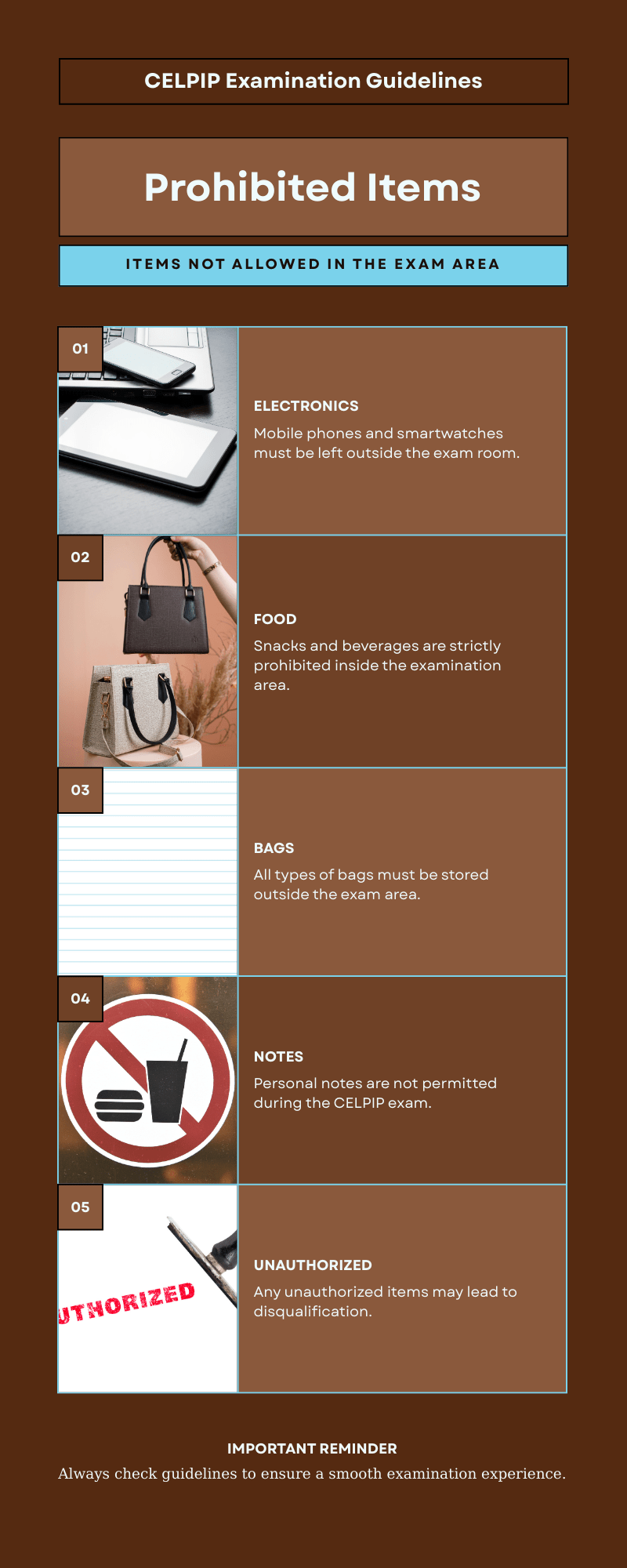
1. Electronic Devices: A Zero-Tolerance Policy Electronic Devices are strictly prohibited from entering exam area, it is on the top list number among prohibited items. This includes mobile phones, smartwatches, tablets, laptops, earbuds, fitness tracking devices like Fitbits, and any other gadgets that could store data, communicate, or record.
As of 2025, this extends to newer wearable tech like augmented reality glasses or health monitors with connectivity features. Why? These devices pose a cheating risk imagine using a smartwatch to glance at notes or receive messages. They can also disrupt the room with notifications or vibrations.
During check-in, you’ll be required to power off and store these in a provided locker or personal property bag outside the room. Only your valid, unexpired passport or government-issued ID is allowed inside. Example: In a case I encountered last year, a candidate forgot to silence their phone, which was hidden in their bag but still vibrated during the listening section. The proctor detected it, leading to the test being halted for that individual and a warning to the room.
The candidate’s scores were invalidated, delaying their permanent residency application by months. To avoid this, I advise double-checking pockets and bags before entering—treat it like airport security.
2. Food and Drinks: Keeping the Environment Clean and Focused No food or beverages are permitted in the examination room, including water bottles, snacks, or even gum. There will be no change in this rule in 2025, but centers will now give escorted access to a place of drinking water, this will only be allowed if you will raise your hand.
Example: A test-taker once tried sneaking energy bars in their sleeve, thinking it would help with concentration during the three-hour test. A routine security scan during a break revealed it, resulting in disqualification. Latecomers are not allowed to give exam, also their fee will not be refunded too.
3. Maintain Integrity: Not allowed to interact with anyone during exam You are strictly prohibited to interact with your fellow test-takers during the test. This encompasses talking, whispering, gesturing, passing notes, or even eye contact that could be interpreted as signaling. In 2025, with more hybrid testing options, in-person centers have added AI-monitored cameras to detect subtle interactions.
This rule safeguards against collaborative cheating and ensures individual performance. Disturbance can affect concentration, especially in the speaking section where your responses are being recorded.
Example: During practicing in a speaking session I noticed, two candidates exchanged some looks and mouthed words. In an actual exam, this may lead a serious problem. Treat every question very seriously, as test includes unscored items for development purposes, as you can’t distinguish them.
4. Cheating or Unauthorized Materials: The Ultimate Red Line Cheating in any form is forbidden, including looking at others’ screens, bringing in notes, using unauthorized aids, or attempting to record the test. Prohibited materials specifically include dictionaries, thesauruses, study guides, or any pre-written content. Pencils, pens, and other writing instruments are not allowed either, as the test center provides scratch paper for notes, which must be returned at the end.
Updates in 2025 emphasize digital cheating prevention, with software scans for external devices. Illegal or dangerous materials, like weapons or substances, are obviously banned and could involve law enforcement. Example: A candidate I advised post-incident had scribbled vocabulary on their arm, hidden under a sleeve. During a random check (now standard), it was discovered, leading to a lifetime ban from CELPIP. Have trust on your preparation.
5. Leaving the Room and Movement Restrictions: You are not allowed to leave the examination area except during 10-minute break which is being given between sections. Unnecessary Movement, Stretching and Wandering are not allowed.
Example: A test-taker went for washroom, missing the break window. Then his test was paused, when he came back he faced deduction in his time, and this lowered his scores.
6. Accessories and Clothing and: Balancing Security and Comfort Certain clothing items are restricted to prevent concealment of cheats. This includes gloves, scarves, hoods, hats (unless for religious or medical reasons, pre-approved), sweaters, jackets, heavy coats, and bulky or large jewelry.
Excessive jewelry is explicitly banned in 2025 updates, aligning with online protocols requiring 360-degree scans. Why? Items like hoods could hide earpieces, and bulky clothes might conceal devices. You’ll be asked to roll up sleeves or empty pockets during check-in.
Example: A candidate wore a heavy necklace with a hidden USB drive, intending it as a “good luck” charm. Security flagged it, resulting in confiscation and a stressful start to the test. Opt for simple, layered clothing you can adjust without excess.
7. Other Miscellaneous Prohibitions: Fitness tracking devices fall under electronics but warrant mention due to their subtlety. Also, no paper or notes from outside the center supplies and collects them to prevent leaks. In 2025, with rising health awareness, medical masks are allowed if needed, but must not obscure identity.
Consequences and Preparation Tips Violations can lead to warnings, score invalidation, or reporting to immigration authorities, as CELPIP scores influence high-stakes decisions. In my experience, 20% of issues stem from oversight, not intent—always err on caution.