Canada Study Permit: Canada offers many immigration pathways which can help in achieving your dream of studying or working in Canada. You need to choose the right pathway, i.e. A Canada Study Permit or a work permit according to your eligibility. Knowing the difference between the both pathways is essential as both have different eligibility requirements.
This guide provides helpful information to improve your chance of a successful application along with up-to-date policy information, helpful tables, and current policies now in effect. Additionally, visit celpip.biz for information about the CELPIP and other English proficiency measures. CELPIP.biz has the training materials you need for a reliable language test designed for all of these processes.
Canada Study Permit
An official document issued by Immigration, Refugees and Citizenship Canada (IRCC) which gives the international students to study in Canada at Designated Learning Institutions (DLIs). A study permit is different from a visa. This gives you right to stay or work in Canada but you will need a temporary resident visa or a electronic travel authorization (eTA) to enter the country.
Types and Subtypes of Canadian Study Permits
Type / Program | Description | Key Features & 2025 Updates |
Standard Study Permit | For full-time academic, vocational, or professional studies at a DLI | Requires a letter of acceptance, proof of funds, PAL |
SDS (Student Direct Stream) | Fast-track process for select nationals like India, China and Philippines | Minimum IELTS 6.0, GIC for living costs, 20-day process |
Non-SDS (General) | Standard route for all other countries/complex profiles | Proof of funds, language test, 8-12 week process |
Short-term/Exchange | For programs lasting 6 months or less, or exchange/unaccredited programs | Usually does not require a permit if ≤6 months |
Primary/Secondary School | For minors attending Canadian elementary/secondary schools | Must have a guardian/arrangements for minors |
Renewal | For ongoing studies requiring permit extension | Not limited by the annual study permit cap |
Latest 2025 Policy Updates
- Study Permit Limit: In 2025, Canada has planned to impose a limit of 437,000 study permits, which for the first time will include most master’s and PhD students, too.
- Provincial Attestation Letter (PAL): All applicants (apart from renewals or elementary/secondary/minor studies) will need to submit a PAL along with their application as of January 22, 2024.
- Proof of Funds: The funds (GIC for SDS, bank statements, financial aid, etc.) must clearly cover tuition and living expenses for the minimum funds required.
- Language Requirement for PGWP: As of November of 2024, a minimum of CLB 5 language proficiency is required to qualify under PGWP. You can take the CLPIP test for language requirements.
- Eligible Fields for PGWP: As of July 2025, not all programs are eligible for PGWP. only programs under active Classification of Instructional Programs (CIP) are eligible. Short term programs or vocational courses are removed from the list of the eligible programs.
Eligibility Criteria
- Acceptance letter from a designated learning institution (DLI).
- Proof of enough financial support.
- A valid passport (and supporting documents) and a clean background.
- A medical exam and/or biometrics for certain nationalities.
- Payment of a non-refundable application fee of CAD 150.
SDS vs. General (Non-SDS) Category
Feature | SDS | General (Non-SDS) |
Processing Time | ~20 days | 8–12 weeks |
Language Score | IELTS 6.0 (min 5.5 band in each) | IELTS min 6.0 overall |
Financial Proof | GIC required | Sufficient funds |
Countries | Limited to a select few | All others |
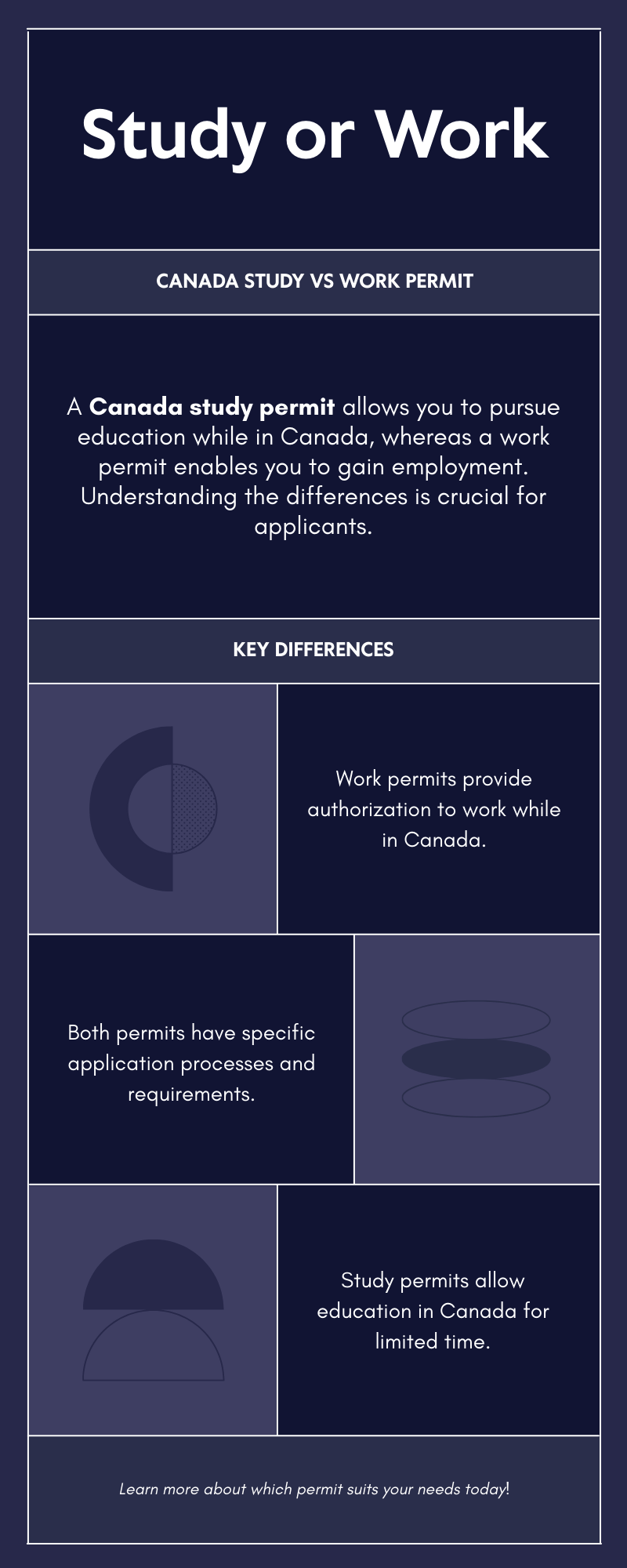
Work Permits in Canada
A legal document which allows foreign nationals to work and stay in Canada. It may be tied to an individual employer, or “open.” Most work permits have to do with a job offer or program, for example post-graduation work permits.
Major Types and Subtypes of Canadian Work Permits
Permit Type | Eligibility / Use Case | Main Features |
Employer-Specific (Closed) | Offered for a specific employer / location | Requires LMIA or proof of exemption, contract needed |
Open Work Permit | Allows work for most employers | For spouses of students/workers, PGWP, or other qualified groups |
LMIA-Based | Most regular job offers | Employer must get government LMIA approval |
LMIA-Exempt (IMP) | USMCA/CUSMA, Intra-company transfers, | Fewer restrictions, no LMIA, often job-specific |
Post-Graduation (PGWP) | For graduates of Canadian institutions | Open, up to 3 years, only for eligible programs/fields |
Post-Graduation Work Permit (PGWP) updates 2025:
- Eligibility Criteria: Instead of a major of study. Only programs on the active approved list for PGWP count for non-degree; most degrees apply.
- Language Test: The new requirement to prove a CLB 5/IELTS/CELPIP for non-degree holders.
- Application Time Limit: Must apply within 180 days of finishing program; online only to IRCC.
- Cap and Approval: IRCC does show that, so far, I believe it also stated that PGWP stats show a 30% decrease in approvals for PGWP in 2025, due to these tighter rules.
Permit Type | Duration | Restrictions | Comments |
Employer-Specific | 1–3 years | Employer, role, location | Need a new permit to change jobs |
Open Work Permit (incl. PGWP) | Varies by basis | Not for banned employers | Most flexible |
Spousal Open Work Permit | Tied to spouse’s permit | Spouses of students/foreign workers | |
LMIA-based | 2–3 years or less | As per job offer/LMIA | Most common route outside PGWP |
IMP LMIA-Exempt | Varies | Case-specific | Intra-company, trade, cultural, etc. |
Required Documents (Typical for Work Permits)
- Valid job offer or contract.
- If required a valid LMIA or LMIA exemption proof.
- Valid Passport or Copy of valid Identity Document.
- Medical exam and biometrics if relevant.
- Additional proof for spouses/dependents.
Summary Table: Canadian Study Permit vs. Work Permit
Aspect | Study Permit | Work Permit |
Main Purpose | Full-time course of studies at DLI | Allows on-campus or off-campus temporary legal work |
Subcategories | SDS, General, Short-term, Renewal, etc. | Employer-Specific, Open, LMIA-based, PGWP |
Visa Type | Not a visa (Tied to TRV/eTA) | Sometimes with an entry visa |
Recent Policy Changes | Cap, PAL, PGWP eligibility changes | Field-based PGWP, Continued LMIA exemptions |
Work Rights | Limited to 20 hours per week; full-time in breaks | As per permit; open permits are the most flexible |
PGWP Pathway | PGWP for eligible graduates | Not eligible for all work permits |
Family Inclusion | Spousal open work permit available for spouses | Dependent (sometimes) for dependents |
Processing | SDS is fast-track for some, general for others | Based on program, employer, LMIA, etc. |
Latest Policy Updates and Suggestions
2025 Changes: Immediate changes for PGWP regarding stricter rules surrounding institutional eligibility and language assessment. Limiting study permit numbers to control flow to international students will impact eligibility.
Real-Life Implications: When planning programs it will be increasingly important to consider program and Institute, especially for PGWP and immigration in the future.
Language Testing Protocol and Institutions: Both CELPIP and IELTS are generally accepted language testing options for study permits and SGWP. Find a solid source of study like celpip.biz.
Review Lists Regularly: The lists of eligible fields and DLIs for PGWP and study permits can change. Always pay attention to and read the most recent IRCC notices, or speak with a Master in the field.
Proof First: Have strong language testing results, financial proof, and know your program or institution details.
Plan for Post-Graduation: Know how your course and school will set up your PGWP and path to Permanent Residence if that is your goal.
Use a trusted source: There is training available for CELPIP and other English language testing at celpip.biz for ready to study and work permits.