As an expert in English language proficiency testing, I have closely followed the evolution of the Canadian English Language Proficiency Index Program (CELPIP), particularly its Reading section, which remains a cornerstone for assessing candidates’ comprehension skills for Canadian immigration, citizenship, and professional purposes.
The CELPIP Reading section evaluates a candidate’s ability to interpret and analyze written English in real-world contexts, making it essential for success in academic, professional, and social environments in Canada.
This article provides a comprehensive overview of the CELPIP Reading section’s format, highlights updates as of August 2025, and offers expert preparation strategies with practical examples.
Overview of the CELPIP Reading Section
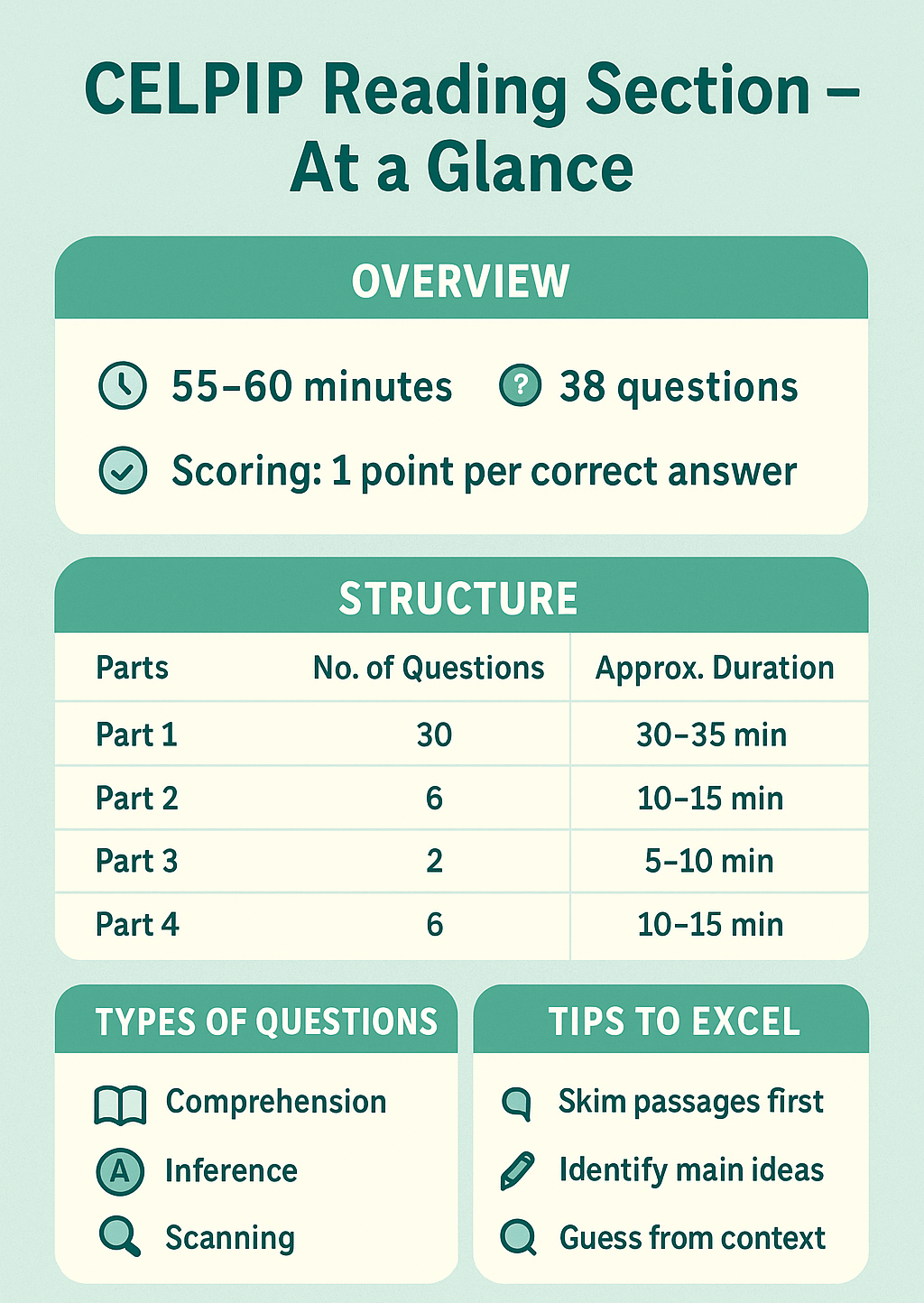
The CELPIP Reading section is designed to measure a candidate’s ability to understand and process written English across diverse scenarios, such as workplace communication, academic texts, and public discourse. Administered by Paragon Testing Enterprises, the test is computer-delivered and takes approximately 55–60 minutes to complete. It is divided into four parts, each targeting specific reading skills:
- Part 1: Reading Correspondence – Focuses on understanding everyday communication, such as emails or letters.
- Part 2: Reading to Apply a Diagram – Tests the ability to interpret visual information alongside text.
- Part 3: Reading for Information – Assesses the extraction of specific details from longer informational texts.
- Part 4: Reading for Viewpoints – Evaluates the ability to analyze multiple perspectives in opinion-based texts.
The section’s relevance lies in its alignment with real-world English usage, testing not only comprehension but also critical thinking, vocabulary, and time management. Its calibration against the Canadian Language Benchmarks (CLB) ensures scores reflect practical language proficiency.
Detailed Format of the CELPIP Reading Section (2025)
The structure of the CELPIP Reading section remains consistent with its established format, with minor updates to enhance accessibility and user experience as of August 2025. Below is a detailed breakdown of each part, including timing, question counts, and example tasks to illustrate the test’s demands.
|
Part |
Duration |
Number of Questions |
Description |
|
Practice Task |
N/A |
1 |
A warm-up task to familiarize candidates with the interface and question style. |
|
Part 1: Reading Correspondence |
~11 minutes |
11 |
Read an email or letter and a response, answering questions on purpose, tone, and details. |
|
Part 2: Reading to Apply a Diagram |
~9 minutes |
8 |
Interpret a diagram (e.g., schedule or chart) with accompanying text to answer questions. |
|
Part 3: Reading for Information |
~10 minutes |
9 |
Extract specific details from a four-paragraph informational passage. |
|
Part 4: Reading for Viewpoints |
~13 minutes |
10 |
Analyze perspectives in an article, including a comment with blanks to fill. |
Part 1: Reading Correspondence
- Purpose: Assesses comprehension of conversational or semi-formal communication.
- Format: Candidates read a main text (e.g., an email) and a short response, answering 6 questions about the main text and 5 about the response, focusing on purpose, tone, or missing words.
- Example Task:
- Text: “Dear Sarah, I’m writing to confirm your participation in the community workshop on Saturday at 10 AM. Please let me know if you need transportation.”
- Question: What is the main purpose of the email?
- A) To request workshop materials
- B) To confirm participation
- C) To cancel the workshop
- Correct Answer: B) To confirm participation
- Update (2025): CELPIP has introduced more diverse scenarios, such as workplace emails, reflecting Canada’s multicultural professional environments.
Part 2: Reading to Apply a Diagram
- Purpose: Tests the ability to synthesize information from visual and textual sources.
- Format: Candidates interpret a diagram (e.g., a transit map) and a related text, answering 5 questions about the diagram and 3 about the text.
- Example Task:
- Diagram: A train schedule showing departures from Station X.
- Question: What is the earliest train departure from Station X to City Y?
- A) 7:00 AM
- B) 7:30 AM
- C) 8:00 AM
- Correct Answer: B) 7:30 AM
- Update (2025): Diagrams now include more interactive elements, such as clickable schedules on the test interface, to better simulate real-world navigation tasks.
Part 3: Reading for Information
- Purpose: Evaluates the ability to locate and understand factual details in longer texts.
- Format: A four-paragraph passage (e.g., on Canadian history or environmental issues) with 9 questions, often requiring candidates to match information to specific paragraphs.
- Example Task:
- Passage Excerpt: “The Canadian Pacific Railway, completed in 1885, connected the east and west coasts, fostering national unity.”
- Question: When was the Canadian Pacific Railway completed?
- A) 1880
- B) 1885
- C) 1890
- Correct Answer: B) 1885
- Update (2025): Texts now emphasize contemporary Canadian topics, such as Indigenous history or climate policies, to align with cultural and educational priorities.
Part 4: Reading for Viewpoints
- Purpose: Assesses critical thinking by analyzing multiple perspectives on a topic.
- Format: Candidates read an article with opposing viewpoints and a comment with blanks, answering 5 questions about the article and 5 about the comment.
- Example Task:
- Text Excerpt: “Some argue that remote work boosts productivity, while others claim it reduces team cohesion.”
- Question: What is one argument against remote work?
- A) It increases productivity
- B) It reduces team cohesion
- C) It lowers costs
- Correct Answer: B) It reduces team cohesion
- Update (2025): Questions now place greater emphasis on identifying implicit biases in arguments, reflecting a focus on critical media literacy.
Scoring and Unscored Items
The Reading section is computer-scored out of 38 points, with questions marked dichotomously (correct or incorrect). Unscored items, used for test development, may appear in Parts 2 or 3 but are indistinguishable from scored items, requiring candidates to treat all questions seriously. Scores are aligned with CLB levels (1–12), with higher scores indicating greater proficiency.

Recent Updates to the CELPIP Reading Section (2025)
As of August 2025, CELPIP has implemented several updates to the Reading section to enhance its relevance and accessibility, based on feedback from test-takers and immigration authorities:
- Enhanced Digital Interface: The test interface now features improved navigation, with resizable text windows and high-contrast displays to accommodate accessibility needs, particularly for visually impaired candidates.
- Culturally Relevant Content: Texts now include more Canadian-specific topics, such as multiculturalism, Indigenous perspectives, and regional policies, ensuring alignment with Canada’s social and professional contexts.
- Increased Focus on Inference: Questions in Parts 1 and 4 emphasize inferential skills, requiring candidates to deduce implied meanings or author intent, reflecting real-world demands for nuanced comprehension.
- Time Management Aids: A visible timer for each part, introduced in 2024, remains a key feature, helping candidates pace themselves effectively.
- Expanded Practice Resources: CELPIP has bolstered its official resources, offering updated free sample tests and interactive webinars on platforms like celpip.biz, focusing on strategies for Parts 3 and 4.
These updates, informed by research and test-taker feedback, aim to maintain the test’s validity and authenticity while addressing accessibility and cultural relevance.