

The Canadian English Language Proficiency Index Program (CELPIP) continues to be an essential test for individuals who want to prove their English skills for immigration, citizenship, or employment in Canada. As we head into 2025, the test format remains unchanged assessing Listening, Reading, Writing, and Speaking skills. Immigration, Refugees, and Citizenship Canada (IRCC) still accepts CELPIP scores for various immigration pathways, making strong preparation more important than ever.
With updated guidebooks, interactive online webinars, and improved practice materials, test-takers now have access to smarter learning strategies. One of the most powerful ways to improve your CELPIP performance especially in Writing and Speaking is building a strong, versatile vocabulary.
Why Vocabulary Matters So Much in the CELPIP Test
Vocabulary plays a crucial role in every section of the CELPIP exam:
Listening
A strong vocabulary helps test-takers understand conversations, announcements, and lectures without missing key details or nuances.
Reading
Understanding synonyms, antonyms, and context clues becomes essential as the passages increase in complexity.
Writing
Well-chosen words help you write clear and organized emails, complaint letters, and opinion-based responses. High-scoring responses use varied, natural vocabulary without sounding overly complex.
Speaking
To describe images, solve problems, or give advice, you need expressive and context-appropriate vocabulary. Examiners look for fluency, clarity, and range.
In 2025, examiners continue to reward answers that include natural, varied vocabulary used appropriately. Recent feedback shows that candidates who used collocations and topic-specific vocabulary scored 9 or higher showing just how influential your word choice can be.
The 2025 Approach to Vocabulary Building
Memorizing long lists of words is no longer considered effective. Modern strategies focus on context, application, and real-life Canadian usage, which aligns perfectly with CELPIP’s style.
Here are the best vocabulary-building techniques recommended for the 2025 CELPIP exam:
1. Master Synonyms and Antonyms
Using synonyms and antonyms helps you avoid repetition one of the biggest mistakes in Writing and Speaking.
Instead of repeating “important,” you can use:
Crucial
Significant
Vital
Paramount
Similarly, knowing antonyms helps you make clear comparisons:
Beneficial vs. Detrimental
Increase vs. Decline
Support vs. Oppose
2025 Tip:
Create theme-based vocabulary lists, such as:
Environment: sustainable, eco-friendly, wasteful
Workplace: deadline, collaboration, productivity
Rewrite sample sentences using new synonyms to improve flexibility. This boosts both comprehension and production skills.
2. Learn and Use Collocations
Collocations are natural word combinations that native speakers use. They make your English sound fluent and polished.
Examples include:
Heavy traffic (not strong traffic)
Make a complaint (not do a complaint)
Take responsibility (not accept responsibility in all contexts)
CELPIP-Specific Collocations
Writing Task 1 (Email):
Express concern
Provide feedback
Request clarification
Speaking Task 8 (Describe a Scene):
Bustling city
Peaceful landscape
Well-maintained park
2025 Tip:
Read Canadian news websites or listen to podcasts and note down collocations in context. Many new study tools now include collocation-based exercises and daily vocabulary playlists.
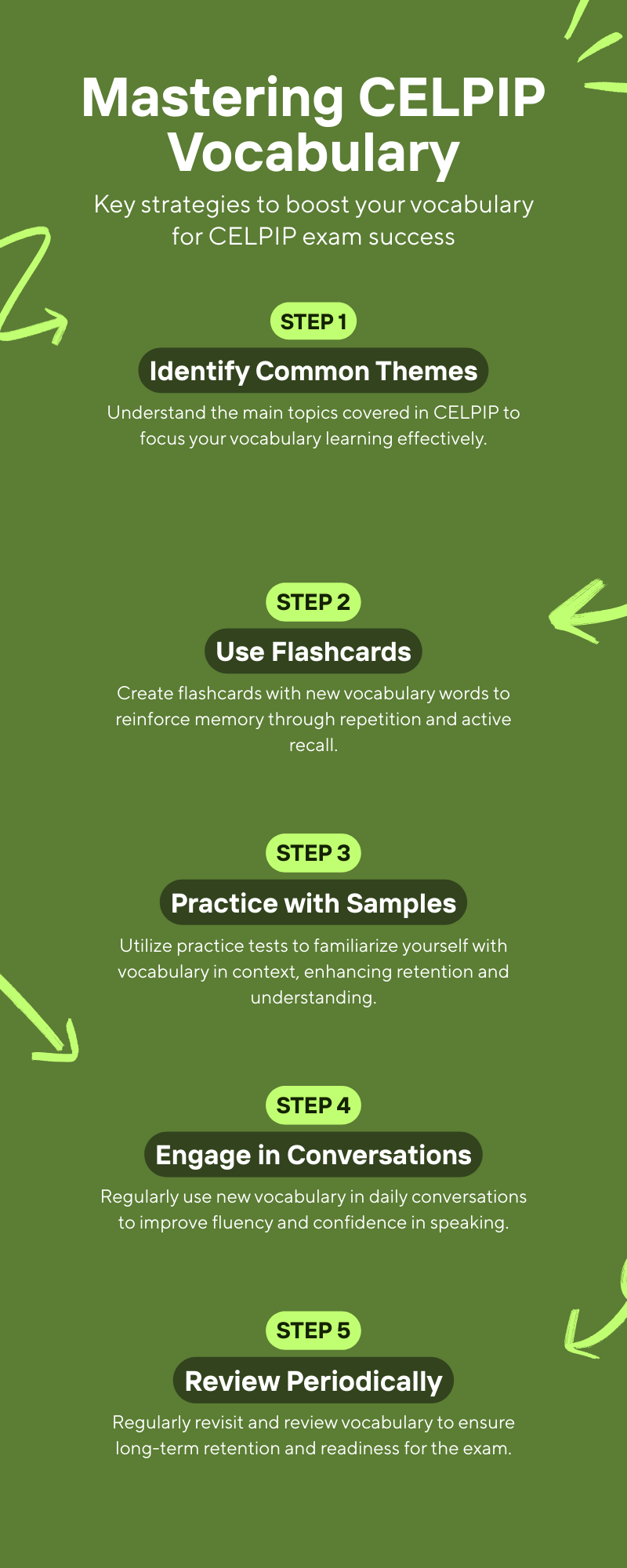
A strong vocabulary is one of the biggest advantages you can have on the CELPIP test. Whether you are listening, speaking, reading, or writing, the right words help you express ideas clearly and understand them quickly. The 2025 updates to CELPIP focus more on natural, meaningful vocabulary use, so it’s important to build the right habits from now.
Why Phrasal Verbs and Idioms Matter
Idioms such as “hit the nail on the head” (exactly right) and phrasal verbs like “turn down” (reject) make your English sound natural and fluent. They appear often in Listening tasks and help improve Speaking responses.
However, using them incorrectly can confuse the listener. For 2025, experts recommend focusing on 50–100 high-frequency expressions, such as:
Phrasal Verbs: get along with, look into, run out of, put off
Idioms: piece of cake, on the same page, under the weather
Use these naturally not forcefully. For example, instead of saying “the meeting extended,” say “the meeting ran over time.” Also remember: phrasal verbs are great for speaking, but avoid them in very formal writing.
Boosting Scores with Academic Vocabulary
To score higher, you need more than casual language. Academic words such as analyze, implication, framework, and empirical evidence help create strong arguments especially for opinion-based tasks.
The goal for 2025 is to know 150+ Academic Word List (AWL) vocabulary items. Build your list using categories like:
Technology: innovation, automation, disruptive
Health: wellness, diagnosis, pandemic
Environment: biodiversity, sustainability, conservation
Study word families: prefixes (un-, pre-, re-) and suffixes (-tion, -ive, -ment) to expand your vocabulary more efficiently.
How to Choose the Right Words During CELPIP
1. Understand the Task Purpose
Check the prompt before writing or speaking.
A formal email needs polite, professional vocabulary.
A scene description needs descriptive adjectives.
An opinion task needs persuasive vocabulary.
2. Avoid Slang
Never use casual words like gonna, cool, or kinda. Replace them with:
going to
impressive
rather
significantly
Using slang is considered “misalignment,” and it reduces your score.
3. Match Tone and Register
Your tone must suit the audience:
Opinion tasks → persuasive and confident
Complaint letters → polite but firm
Descriptions → clear and detailed
Use connectors such as furthermore, in addition, however to improve flow.
4. Practice Vocabulary in Context
It’s not enough to memorize words you must use them.
Try:
Writing sample emails with new words
Recording your speaking responses
Listening back to check naturalness
Asking for feedback from a friend or tutor
For Speaking tasks, practice prepositions like next to, behind, in front of, which help you describe scenes clearly.
Daily Practice = Higher Scores
Vocabulary grows best through consistent, daily practice, not last-minute cramming. Read articles, listen to English podcasts, and speak a little every day. Mock tests help you check your progress, fix mistakes, and build confidence.
Websites such as CELPIP.BIZ offer updated practice tests that match the 2025 guidelines.
Final Thoughts
The CELPIP exam is not only about knowing words—it’s about choosing the right words at the right time.
To succeed in 2025:
Build vocabulary through synonyms, collocations, idioms, phrasal verbs, and academic words.
Match your vocabulary to the task.
Avoid casual or repetitive language.
Practice daily using real-life tasks and mock exams.
If you follow these strategies consistently, your vocabulary will become your strongest weapon and your CELPIP score will reflect it.


