
If you want to bring your spouse or partner to Canada, there are two main pathways to choose from: Inland and Outland Spousal Sponsorship. Both programs fall under Canada’s Family Class Immigration and allow Canadian citizens or permanent residents to sponsor their spouse, common-law partner, or conjugal partner.
Choosing the right pathway is important for faster processing, eligibility, and convenience. In this guide, we explain the differences between Inland and Outland Sponsorship to help you decide which option is right for your situation.

Understanding Inland and Outland Spousal Sponsorship
A Canadian citizen or permanent resident can sponsor their spouse or partner if they are in a genuine, committed relationship with a foreign national. The relationship must fall under one of these categories:
-
Spouse: Legally married as per Canadian law
-
Common-law partner: Lived together for at least 12 consecutive months
-
Conjugal partner: In a committed relationship for 12 months but unable to live together due to circumstances beyond your control (e.g., immigration issues, marital status, cultural barriers)
Once you qualify as spouses/partners, you can apply through Inland or Outland Sponsorship.
1. Outland Spousal Sponsorship
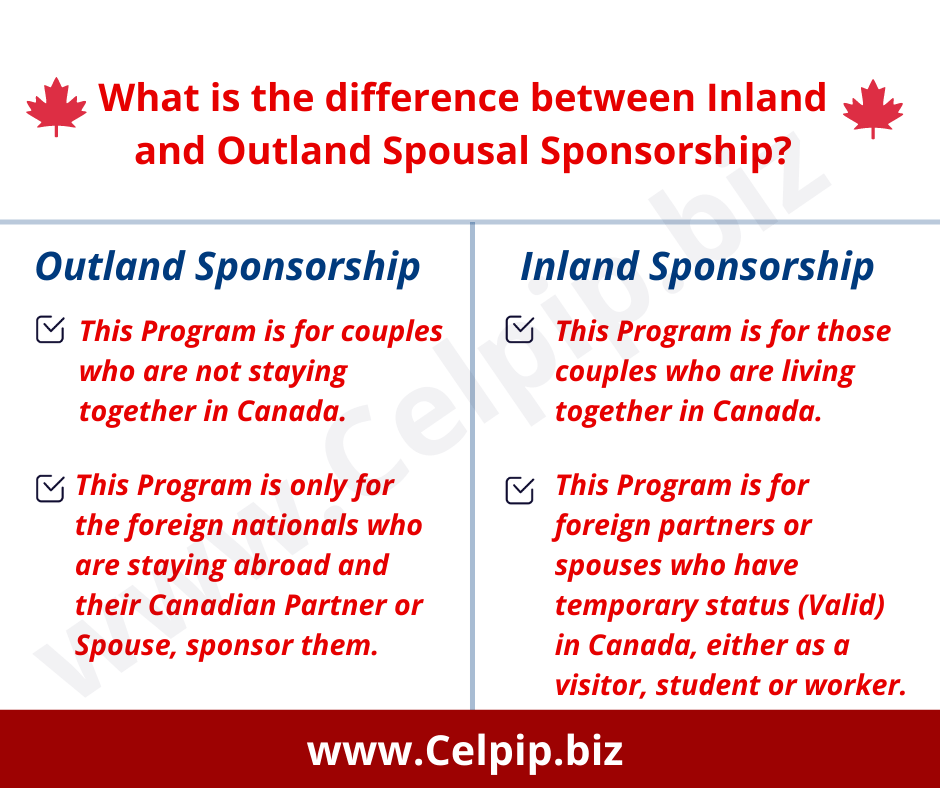
Outland Sponsorship is designed for couples who do not live together in Canada. The foreign spouse is living outside Canada or cannot legally remain in Canada during the application process.
Who Should Choose Outland Sponsorship?
This option is ideal if:
-
The sponsored person lives outside Canada
-
The applicant needs to travel frequently during processing
-
The couple is in a conjugal relationship (only eligible under Outland)
-
The foreign partner is not eligible to remain in Canada
Eligibility Requirements for Outland Sponsorship
Both the sponsor and sponsored person must meet the following conditions:
- Sponsor must be a Canadian citizen or permanent resident
- Both must be 18 years or older
- Relationship must be spouse, common-law, or conjugal
- Neither partner can be involved in bankruptcy or serious criminal charges
- Sponsor must not have sponsored a spouse in the past 5 years
Advantages of Outland Sponsorship
-
Travel-friendly: The applicant can travel in and out of Canada during processing
-
Suitable for conjugal partners
-
Flexible residency: The applicant does not need to stay in Canada
2. Inland Spousal Sponsorship
Inland Sponsorship is for couples who currently live together in Canada. The foreign spouse must be in Canada on a valid temporary status such as a visitor visa, work permit, or study permit.
Who Should Choose Inland Sponsorship?
Choose this pathway if:
-
The couple lives together in Canada
-
The foreign partner can legally remain in Canada throughout processing
-
The applicant wants to work while waiting for PR
Eligibility Requirements for Inland Sponsorship
- Sponsor must be a Canadian citizen or permanent resident
- Both must be at least 18 years old
- Relationship must be spouse or common-law (conjugal not allowed under Inland)
- Neither partner can have bankruptcy or criminal issues
- Sponsor must not have sponsored a spouse in the past 5 years
Major Advantage: Open Work Permit
One of the biggest benefits of Inland Sponsorship is the Spousal Open Work Permit (SOWP).
This allows the sponsored person to work full-time in Canada while IRCC processes the PR application.
Inland vs. Outland Sponsorship: Key Differences
| Feature | Inland Sponsorship | Outland Sponsorship |
|---|---|---|
| Applicant is inside Canada? | Yes | Not required |
| Can applicant travel? | Not recommended | Yes, travel allowed |
| Open Work Permit? | Yes | No |
| Suitable for conjugal partners? | No | Yes |
| Processing time | ~12 months | ~12 months |
Where to Submit Your Application?
-
Outland Applicants: Submit through the Visa Office that serves your country.
-
Inland Applicants: Submit through IRCC’s inland processing office in Canada.
Processing Time
Whether you apply through Inland or Outland Sponsorship, IRCC processes most applications in approximately 12 months.
Quick Summary
- Inland Sponsorship: For couples living together in Canada
- Outland Sponsorship: For couples living apart or when travel is required
- Outland allows travel during processing
- Inland offers an Open Work Permit
- Both require age, relationship, and background eligibility
- Average processing time: 12 months