

Canada Work Permit: If you’re looking to develop your career as a skilled worker, start a business venture, or attend a Canadian business gathering, it is essential to understand the difference between a work permit and a business visa.
The processes for obtaining either type of documentation, privileges associated with either, and pathways toward residency differ greatly and, with the 2025 update, it is more incumbent than ever to choose the right documentation for your end goals.
If you are studying for the English-proficiency component associated with either a work permit or a business visa, celpip.biz has study resources for the CELPIP and other relevant English proficiency testing options.
The Essentials: Canada Work Permit and Business Visas
Canadian immigration makes a distinction between “work permits” (for paid work) and “business visas” (for short-term business activities, entrepreneurship, or investment). In this review, we will lay out the main distinguishing characteristics and several of the different types for each.
Finally, we will review the latest 2025 updates for both categories, which is now perhaps the most essential part of the overall decision process.
Work Permits: For Employment in Canada
A legal document which allows the foreign workers to work in Canada. A work permit can be a employer-specific or a open work permit. Currently, the Canadian work permit have stricter eligibility criteria to focus on skilled workers and to expand pathways for workers with external or basic skills.
Main Types of Canadian Work Permits
Permit Type | Description & Use Case | Main Requirements (2025) |
Employer-Specific (Closed) | Tied to job offer and employer, requires LMIA | LMIA (Labour Market Impact Assessment), contract, CLB 5+ |
Open Work Permit | Allows work for most employers | CLB 5+, no LMIA or job offer required, limited categories |
Bridging Open Work Permit | For PR applicants waiting for approval | PR application pending, recent work permit, CLB 5+ |
Post-Graduation Work Permit | For graduates of Canadian schools | Graduation from eligible program & institution |
Spousal Open Work Permit | For spouses of eligible foreign workers/students | Modified criteria, more limited in 2025 |
Updates to Work Permit 2025
- Language Requirements: Most open permit categories require enhanced CLB 5 minimum, with an emphasis on French specifically for Quebec and French-speaking Canadians.
- Sectors priorities: Healthcare, IT, trades and agriculture are now classified as fast processing, and more open work permits can be acquired.
- Cap Per Year: 85,000 open permits annually, with quotas for in-demand occupations.
- Application Processing: Permanent applications are now need to be submitted completely online.
- Involving Spouses: Eligibility for open spousal permits has been tightened. Spousal is only now granted only to partners of highly skilled workers and some students.
- Application Fee: The application for work permits has increased to CAD $255 in 2025.
Who Needs a Work Permit?
Most foreign nationals who wish to take up any employment, work on contracts or volunteer Contributions to labour in Canada will or will be needed to obtain a work permit. There are exceptions to this for business visitors, artists, athletes and some intra-company transfer cases (see Business Visa section below).
How Long Does a Work Permit Last?
Work permits may last from 6 months to 3 years in duration, based on the type of permit, employer and immigration program it is based on. Policies regarding how such permits are renewed may be different, especially as it relate to open permits and permits related to PR applications.
Business Visas: For Conferences, Meetings & Business Events
A business visa is a type of temporary visa issued for foreign national business travelers who intend to be in Canada to engage in non-labor based business activities.
Non-labor business activities could mean attending meetings, networking, attending conferences, negotiating contracts, exploring opportunities or opening a business in Canada, but it does not mean working for Canadian wages or providing services to a Canadian client.
Key Canadian Business Visa Categories in 2025
Category | Focus | Typical Duration | Core Activities Allowed |
Business Visitor Visa | Short stays for meetings, events, etc. | Up to 6 months | Meetings, conferences, market research |
Start-up Visa Program | Innovative entrepreneurs | PR pathway | Launching scalable startups |
Self-Employed Persons Program | Cultural/athletic/self-employed work | PR pathway | Self-managed careers |
Provincial Nominee Business | Entrepreneurs investing in provinces | PR pathway | Regional business investment |
Investor Visa (Quebec) | High net-worth investors | PR pathway | Major investments in Quebec |
Updates to Business Visas (2025)
- Simplified documentation. Decreased financial obligations for eligible applicants, with a special focus on designated regions.
- Regional emphasis. Priority consideration for provinces with acute labor shortages.
- Language flexibility. French proficiency incentivized; most federal programs require English (prepare through celpip.biz).
- Processing times. Business visitor visas and business PR pathways have prompt application processing times availability, for eligible applicants in compliance.
What Activities are Allowed Under a Business Visitor Visa?
- Participate in meetings and negotiate contracts
- Attend trade shows/exhibitions and seminars/conferences
- Explore Canadian markets for the purpose of investment
- Attend corporation training related to your company (cannot undertake actual job duty)
You cannot:
- Work for a Canadian company (paid)
- Provide local services or physical labour
- Receive a wage (unless under an approved self-employed or PR stream)
Startup and Entrepreneur Paths for Business Immigration
- Start-Up Visa Program
- For founders of innovative, scalable businesses that have the support from a Canadian venture capital fund or Canadian angel investor group or with the support of a Canadian business incubator.
- Requirements: 10+ percent ownership, business plan, CLB 5+ English or French, sufficient funds, scalable business.
- There is a direct pathway to PR if you satisfy the requirements.
- Self-Employed Persons Program
- This program is for individuals who have sufficient experience in athletic or cultural activities and are trying for PR in Canada.
- To be eligible for this program, minimum 2 years of experience is required in the relevant field.
- Provincial Nominee Business Programs
- Every province in Canada, such as Ontario or Alberta, has a business program that provides immigration opportunities for those interested in investing in Canada. Each province will have different requirements (net worth, business experience, and minimum investment) depending on the entrepreneur stream.
- Most programs offer a PR opportunity, provided the long-term conditions are met.
- Investor Visa (Quebec)
- The Quebec Investor Program requires a substantial investment and proof of business management expertise, along with proficiency in English or French.
- The investment threshold for the Quebec Investor visa is CAD $800,000 and is expected to open in late 2025 again.
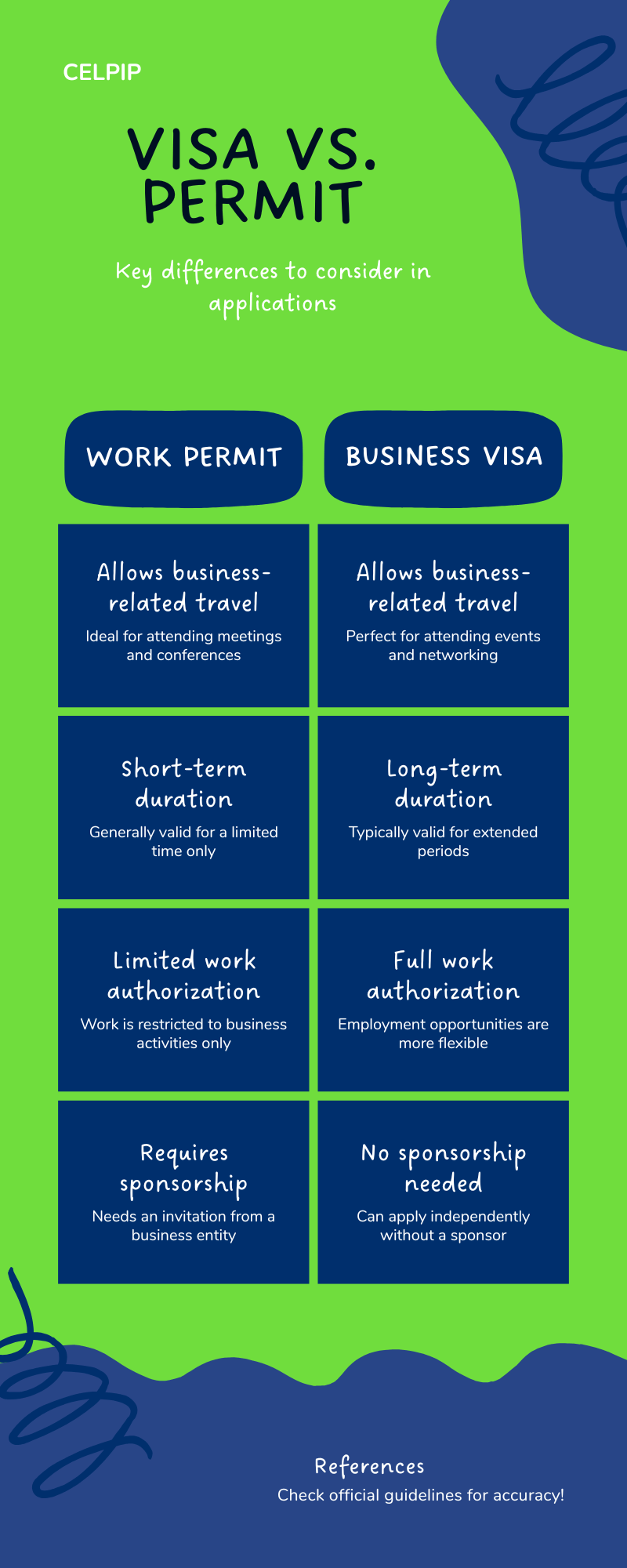
Comparison Table for Work Permit and Business Visa
Aspect | Work Permit | Business Visa |
Main Purpose | Paid employment | Conferences, Meetings and business trips |
Who Needs It | Prospective employees, contractors | Executives, investors, entrepreneurs, visitors |
Activities Allowed | Full/part-time work, paid labor | Business exploration, NOT paid work |
Duration | 6 months to 3 years | Up to 6 months (visitor); as PR if eligible |
PR Pathway | PGWP, Express Entry, PNP, AIP | Startup, entrepreneur, self-employed, PNP PR |
Recent Changes | Stricter language & skill rules | Streamlined for qualified business immigrants |
Fees (2025) | CAD $255 and up | ~CAD $100 (visitor) / $1500+ (business PR) |
Language Test | CLB 5+ required (French/English) | English/French for PR programs, not short stays |
Family Inclusion | Spouse can get open work permit | PR streams allow whole-family immigration |
2025: New Trends & Tips
The eligibility of work permits is expedited. Canada is focusing on fields in healthcare, skilled trades, and technology for fast-track approvals.
A high-skilled job is required for spousal open work permits now. Please check the eligible job list before applying for a spousal open work permit.
The provincial business immigration streams vary each year; some have no annual quotas-creating flexible pathways for genuine business investor.
If you are looking for support in English or French language proficiency for your application, celpip.biz is your trusted one-stop source for official CELPIP and IELTS practice tailored for Canadian immigration.
Selecting the right Pathway
You should choose the Work Permit if you want to legally work in Canada. Check your eligibility according to the needs of the relevant sector and meet the language proficiency requirements. Also, check if you need an LMIA or are eligible for an open permit.
You should select the Business Visa if you are planning to open a business or startup. You can also do a market research for your business and can attend relevant business meetings. You will not get wages like on work visa. This is also a best PR link route. This includes Start-Up Visa and Self-Employee.
2025 Canadian immigration pathways are best for skilled applicants with language proficiency, and innovative/creative entrepreneurs. Make a planned/educated choice as your pathway, ensure you qualify, and keep watching the announcements from IRCC in particular.
If you want more information on a particular language exam needed for both the work permit and the business immigration streams, please check out celpip.biz.
If you would like a more detailed breakdown of a particular program, changes to rules/the latest information, or updates on recent changes in any application process, please let us know through the comment section. We will provide clarity on an important detail relevant to your application.


