
The IRCC conducts the Canadian Citizenship Test for individuals who wish to become Canadian citizens. Anyone between the ages of 18 and 54 must take this test as part of the application process.
You can take the test in English or French. It is usually a written test, but in some cases, it may be given orally. The test lasts for 30 minutes and contains 20 questions, which can be either multiple choice or true/false.
To pass the test, applicants must answer at least 15 questions correctly. Another important requirement is that applicants must be physically present in Canada while taking the test.

Who Can Take the Canadian Citizenship Test?
Applicants who are 18 years or older must take the citizenship test. For applicants younger than 18, their parents or guardians must apply on their behalf.
The applicant must also prove their ability to speak and write in English or French. They should be permanent residents living in Canada. These form the basic requirements for Canadian citizenship.
Applicants who have served in the Canadian Armed Forces may qualify for a fast-track application process. It is recommended to review the complete list of requirements on the official IRCC website.
Significance of the Test
The citizenship test evaluates how much applicants understand about Canada’s history, government, laws, and values. It ensures that new citizens are aware of their rights, responsibilities, and Canada’s cultural foundations.
What the Test Covers
The test includes questions on:
-
Rights and responsibilities of Canadian citizens
-
Canadian history
-
Canada’s political system
-
Physical and political geography
It also covers Canadian values such as democracy, gender equality, and human rights, as well as information about Indigenous peoples and their culture.
How to Study for the Test
The official study guide is available for free. Applicants can access it in several formats: online, MP3 audio, PDF, eBook, or printed copy. Studying the guide helps applicants understand their rights, duties, and key topics included in the test.
Getting Your Test Date and Interview
You may be asked to take the test a few weeks after receiving confirmation that your application has been received. Usually, you will get 1–2 weeks’ notice before your test date.
If you cannot attend your appointment, you must request a new date and provide a valid reason. Failing to do so may delay or even stop the processing of your application. You can inform the IRCC through email, mail, or an online form.
Only the applicant is allowed in the testing room. If you bring a child, ensure someone can take care of them outside the room.
What to Bring to the Test
Applicants must bring:
-
The test invitation notice
-
Two IDs (one must include a photo and signature)
-
Any government-issued IDs from their home country
-
All passports and travel documents
-
Language proof, such as a certificate, diploma, degree, or transcript
If documents are not in English or French, you must include a translation with an affidavit.
Taking the Test
You may take the test in English or French, and it lasts 30 minutes. There will be 20 questions, and you must score 15/20 to pass.
Most applicants take a written test. However, if an applicant has difficulty reading or writing in English or French, they may be asked to take an oral test instead.
A citizenship officer conducts the oral test. It may take place on the same day or within 4–8 weeks after the written test. Applicants will be informed if the hearing is scheduled for a later date.
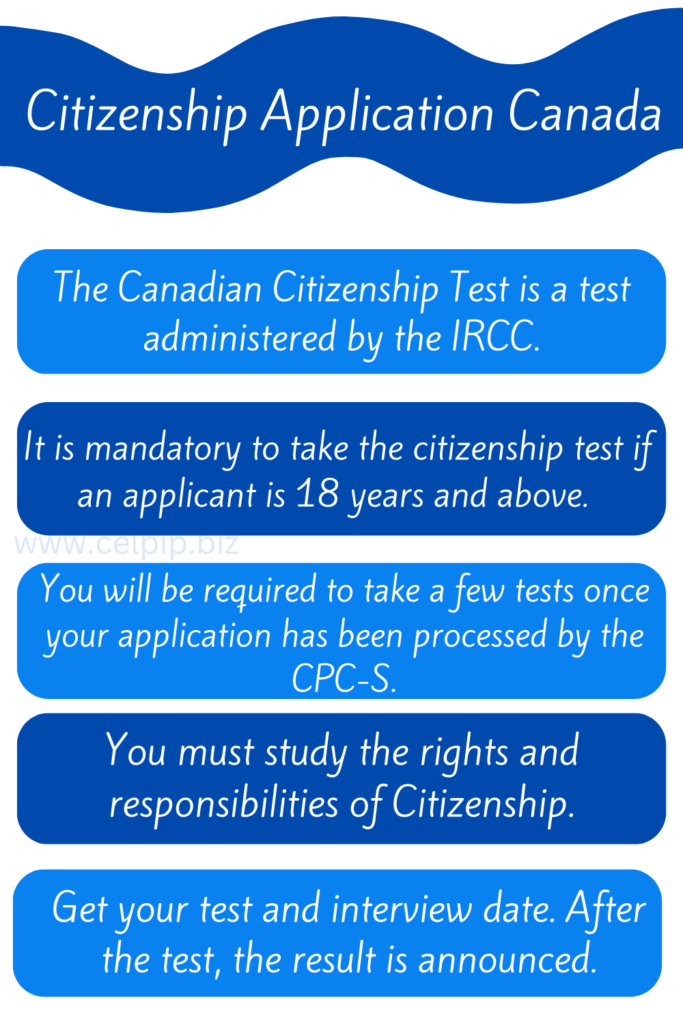
The IRCC conducts the Canadian Citizenship Test for individuals applying for Canadian citizenship. All applicants between the ages of 18 and 54 must take this test.
You can choose to take the test in English or French. Most often, the test is written, but in some cases, it may be conducted orally. The test duration is 30 minutes, and it includes 20 questions in true/false and multiple-choice formats.
To pass, applicants must score at least 15 correct answers. Also, applicants must be physically present in Canada while taking the test.
Who Must Take the Citizenship Test?
If the applicant is 18 years or older, taking the test is mandatory.
Applicants under 18 years do not need to take the test; instead, their parents or guardians must apply on their behalf.

Language and Residency Requirements
Applicants must demonstrate the ability to speak and write in English or French.
They must also be permanent residents of Canada.
Those who have served in the Canadian Armed Forces may apply through a fast-track process. It is advisable to check the detailed eligibility criteria on the IRCC official website.
Importance of the Test
The test evaluates how well applicants understand Canadian history, values, government, and laws.
Topics Covered in the Test
The test includes questions on:
-
Rights and responsibilities of Canadian citizens
-
Canadian history
-
Canada’s political system
-
Physical and political geography
-
Canadian democratic values, gender equality, and human rights
-
Indigenous peoples and their culture
How to Prepare
IRCC offers a free official study guide. You can read it online, download the PDF, get the eBook, or listen to the MP3 version. A physical copy can also be ordered.
Receiving the Test Date
After IRCC acknowledges your application, you may be scheduled for the test within a few weeks.
You will receive a 1–2 week notice before the test date.
If you cannot attend, you must request a new date and provide a valid reason. Failure to respond may cause delays or rejection.
Only the applicant can stay in the test room. Children may wait outside with a caregiver.
What to Bring for the Test
Bring:
-
Your test notice
-
Two IDs (one must show your photo and signature)
-
All passports and travel documents
-
English/French language proof (certificate, diploma, transcript)
-
Translations for documents not in English or French (with translator affidavit)
Taking the Test
The test can be written or oral. Citizenship officials may choose the oral format if you have difficulty reading or writing in English or French.
The oral test is conducted by a citizenship officer. It may occur on the same day or within 4–8 weeks after the written test.
After the Test: Results, Interview & Next Steps
After the test, you will have an interview with a citizenship official. During the interview, the official will:
-
Give your test results
-
Assess your English or French speaking skills
-
Review your application and original documents
-
Answer any questions you have
-
Check if you meet all requirements
If you qualify, you will receive the date of your citizenship ceremony through email or letter.
If You Fail the First Test
If you fail the written test but meet all other requirements, a second test will be scheduled within 4–8 weeks.
If you fail again, you will be invited for a citizenship hearing, either in person or via video conference. The hearing lasts 30–90 minutes.
If you fail the hearing (third attempt), your application will be refused, but you may apply again.
If applying with family, all applications are processed together. If you face delays or hearings, your family’s applications may pause until yours progresses.
Becoming a Canadian Citizen
To become a Canadian citizen, you must:
-
Be at least 18 years old
-
Have lived in Canada for at least 1095 days
-
Have filed your taxes
-
Not be prohibited under sections 21 or 22
-
Know English or French
-
Understand citizenship rights and responsibilities
Who Cannot Get Citizenship?
You may be refused if:
-
You have a criminal record
-
You committed a crime outside Canada
-
You are under a deportation order
-
You previously lost Canadian citizenship
-
You do not meet eligibility requirements
-
You gave false information earlier
Applying for Citizenship: Step-by-Step
1. Citizenship Application Package
Choose the correct application: adult (18+), parent applying for a child, minor under 18, stateless person, or adopted person.
The package includes a guide and document checklist. Multiple applications for a family can be submitted together.
2. Pay the Citizenship Fees
Fees must be paid in Canadian dollars.
They are non-refundable.
Family applications can use one payment receipt.
3. Submit Your Application
After completing all forms and paying the fees, mail your application to the Case Processing Center – Sydney.
Incomplete applications will be returned.
4. Citizenship Knowledge Test
CPC-S will review your application and schedule your test.
Adults must score at least 75%.
Applicants aged 55+ are exempt.
After passing, you will attend an interview.
5. Citizenship Oath
After the interview and test, you will take the Oath of Citizenship in English or French.
This is the final step before officially becoming a Canadian citizen.
About IRCC
Immigration, Refugees and Citizenship Canada (IRCC) is the federal department responsible for Canadian immigration, refugee resettlement, and citizenship. Established in 1994, it works alongside Public Safety Canada to ensure the safety and well-being of Canadians.
IRCC also issues Canadian passports and works to help newcomers integrate smoothly into Canadian society.
Guiding Laws
IRCC operates under the Canadian Charter of Rights and Freedoms, the Citizenship Act of 1977, and other regulations.
Funding and Programs
In 2018–2019, IRCC spent over CA$2.4 billion on immigration and settlement programs.
These include:
-
Language training
-
Job-related support
-
Community integration
-
Refugee resettlement assistance
Canada welcomed 25,000 Syrian refugees by February 2016 through three pathways:
Privately Sponsored Refugees, Government-Assisted Refugees, and Blended Visa Office-Referred Refugees.
Citizenship Commission & Judges
The Citizenship Commission oversees citizenship ceremonies, assesses residency requirements, and educates new Canadians about their rights and responsibilities.
Citizenship judges review applications, conduct hearings, and make decisions based on the Citizenship Act.
Current citizenship judges include:
Suzanne Carrière, Hardish Dhaliwal, Carol-Ann Hart, Rochelle Ivri, Joan Mahoney, Marie Senécal-Tremblay, and Rania Sfeir.