To work legally in Canada, most foreign nationals must obtain a Canada work permit. There are two main pathways to do this:
Work Permit Through LMIA
Work Permit Without LMIA (LMIA-Exempt)
Although both options allow individuals to work in Canada, they differ in requirements, procedures, and purpose. Understanding these differences can help you choose the right pathway for your situation.
Canada is one of the most popular destinations for skilled professionals, international students, and entrepreneurs. Its multicultural society, high standard of living, and wide range of job opportunities attract talent from all over the world.
What Is an LMIA (Labour Market Impact Assessment)?
A Labour Market Impact Assessment (LMIA) is issued by Employment and Social Development Canada (ESDC). It confirms that hiring a foreign worker will not negatively affect Canada’s labour market.
In simple terms, a positive LMIA proves that:
No qualified Canadian citizen or permanent resident is available for the job
Hiring a foreign worker is justified
Once an employer receives a positive LMIA, the foreign worker can apply for a closed work permit, which is tied to:
A specific employer
A specific job position
Why Do Employers Need an LMIA?
To obtain an LMIA, Canadian employers must follow a strict recruitment and compliance process, including:
Advertising the job in Canada for a specific period
Offering wages that meet government-approved standards
Complying with all Canadian labour and employment laws
The LMIA process is commonly used in industries facing long-term labour shortages, such as:
Technology
Construction
Agriculture
Healthcare
Manufacturing
What Is an LMIA-Exempt Work Permit?
Not all jobs in Canada require an LMIA. In certain situations, employers can hire foreign workers without proving a labour shortage.
These work permits are issued under the International Mobility Programme (IMP).
LMIA exemptions are granted when hiring a foreign worker provides significant cultural, social, or economic benefits to Canada rather than simply filling a vacant position.
Common LMIA-Exempt Categories
Below are some of the most popular LMIA-exempt work permit streams:
1. Intra-Company Transfers (ICT)
Multinational companies can transfer employees from overseas offices to Canadian branches without an LMIA.
2. International Trade Agreements
Foreign workers may qualify for LMIA exemptions under trade agreements such as:
CUSMA
CETA
GATS
3. Post-Graduation Work Permit (PGWP)
International students who graduate from eligible Canadian institutions can work in Canada without an LMIA.
4. Open Work Permits for Spouses
Spouses or common-law partners of:
International students
Skilled foreign workers
may qualify for open work permits.
5. Religious and Charitable Workers
Individuals working for recognized religious organizations or charitable institutions may also be exempt from LMIA requirements.
Open Work Permits Under LMIA-Exempt Streams
Most LMIA-exempt work permits are open work permits, meaning the holder can:
Work for any employer in Canada
Change jobs without applying for a new permit
Because of this flexibility, LMIA-exempt pathways are highly popular among foreign workers and international graduates.
Key Differences and How to Choose the Right Option
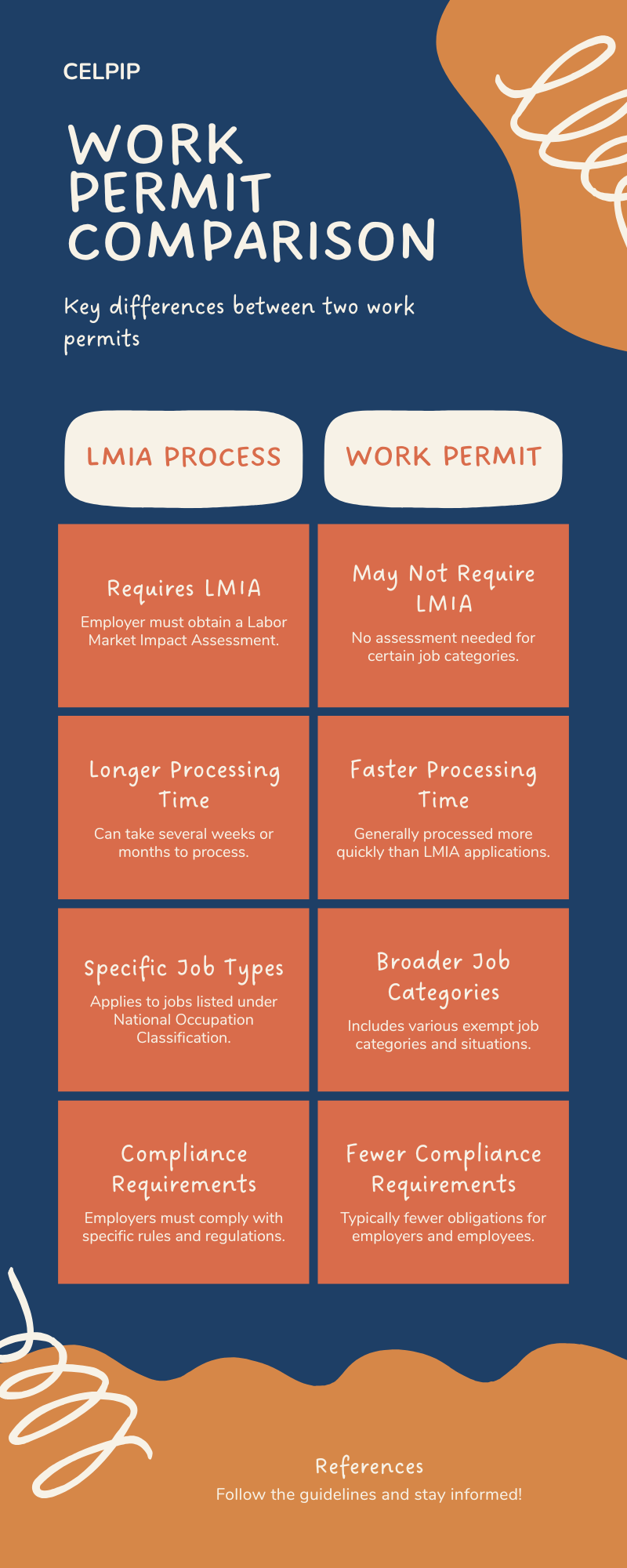
When applying for a Canadian work permit, one of the most important distinctions to understand is whether your application requires a Labour Market Impact Assessment (LMIA) or qualifies for an LMIA-exempt work permit. While both options allow foreign nationals to work legally in Canada, they differ in requirements, processing time, and flexibility.
LMIA-Based Work Permits: Employer Responsibility
For work permits based on an LMIA, the Canadian employer must prove that there is a labour shortage in the region.
This means the employer must demonstrate that:
No qualified Canadian citizen or permanent resident is available for the job
Reasonable efforts were made to hire locally
Only after receiving a positive LMIA can the employer offer the job to a foreign worker, who can then apply for a closed work permit.
LMIA-Exempt Work Permits: Broader Benefits to Canada
LMIA-exempt work permits are issued when a job offer aligns with international agreements or provides significant benefits to Canada, such as:
Social contributions
Cultural enrichment
Economic advantages
In these cases, employers are not required to obtain an LMIA, making the process simpler and faster for both parties.
Processing Time and Application Complexity
The LMIA-based work permit process is more detailed and time-consuming because it involves multiple verification and compliance steps.
In contrast, LMIA-exempt work permits are often processed more quickly and involve fewer formal requirements. For this reason, eligible applicants generally prefer LMIA-exempt options whenever possible.
Work Authorization: Closed vs. Open Permits
Another major difference lies in work flexibility:
LMIA-Based Work Permits
Usually closed work permits
The worker can only work for the employer named on the permit
LMIA-Exempt Work Permits
Often issued as open work permits
Allow the holder to work for almost any employer in Canada
This flexibility makes LMIA-exempt permits especially attractive to international graduates and spouses of skilled workers.
Which Work Permit Is Right for You?
The best option depends on your personal circumstances and eligibility.
Choose an LMIA-Based Work Permit if:
You have a confirmed job offer from a Canadian employer
The employer is willing to complete the LMIA process
Your role fills a genuine labour shortage
Choose an LMIA-Exempt Work Permit if:
You are an international graduate
You are the spouse or partner of a skilled worker or student
You qualify under an international mobility or exchange programme
LMIA-exempt permits are generally faster to obtain and provide greater job flexibility.
Important Things to Consider Before Applying
Before submitting your application, make sure you understand:
Processing times
Required documents
Eligibility criteria for each permit type
Incomplete applications or errors can result in delays or refusals.
Professional Advice Matters
For the best results, it is strongly recommended to consult a licensed immigration consultant or immigration lawyer. Expert guidance can help you:
Avoid costly mistakes
Choose the correct pathway
Improve your chances of approval
Final Thoughts
Both LMIA and LMIA-exempt work permits play an important role in Canada’s immigration system. By understanding the key differences and seeking professional advice, you can make an informed decision and move one step closer to working in Canada.