Traveling to Canada is an exciting opportunity to explore breathtaking landscapes, multicultural cities, and unique Canadian charm. But before you begin the journey, you must ensure you have the right documents for a smooth border-crossing experience.
Among the available identification options, an Enhanced Driver’s License (EDL) stands out as a convenient and efficient choice for land and sea travel. This guide breaks down what an EDL is, how it works, its benefits, limitations, and important entry requirements to help you travel with confidence.
What Is an Enhanced License?
An Enhanced Driver’s License (EDL) is a government-issued ID that functions as both:
A driver’s license, and
A passport alternative for certain types of travel.
It complies with the Western Hemisphere Travel Initiative (WHTI) and is valid for entry into the U.S., Canada, Mexico, and some Caribbean countries (by land and sea).
Key Features of an Enhanced License
Identification:
Contains your basic personal details along with added security features.Cross-Border Travel:
Allows U.S. citizens to enter Canada, Mexico, and some Caribbean nations by land or sea without a passport.Security Features:
Includes advanced features such as:RFID chip
Holographic images
Anti-counterfeit technology
WHTI Compliance:
Fully meets government security standards required for border entry.Limited Use:
Not valid for international air travel or entry into countries outside the WHTI region.Application Process:
Requires proof of identity, citizenship, and residency. Additional documents may be needed depending on your state/province.
Requirements for Traveling to Canada With an Enhanced License
1. Valid Enhanced Driver’s License
You must possess an active EDL issued by the appropriate U.S. state or Canadian province.
2. Citizenship and Residency
EDLs are issued only to:
Citizens or
Legal residents
of the issuing state or province.
3. Identity & Citizenship Verification
During the application process, you will need documents such as:
Birth certificate
Passport
Social Security card
Residency proofs
4. No Legal Restrictions
You must have:
No outstanding warrants
No unresolved legal issues
No border-related violations
5. Meeting Canadian Entry Requirements
Even with an EDL, travelers must show:
A valid reason for visiting Canada
Sufficient funds for their stay
Compliance with Canadian immigration rules
6. Additional Backup Documents
Although optional, it is wise to carry:
A passport
Birth certificate
Vehicle registration and insurance (if driving)
This helps avoid delays if issues arise.
Limitations of Using an Enhanced License
While EDLs are useful, they come with restrictions.
1. Limited Travel Validity
Valid only for land and sea travel, not for air travel.
Not accepted worldwide—only in WHTI-compliant countries.
2. Restricted International Use
EDLs cannot replace a passport for:
Air travel
Entering Europe, Asia, Africa, or most other regions
3. Immigration Compliance Still Required
Even with an EDL, Canada may deny entry if you:
Cannot justify your visit
Lack financial support
Have a criminal or immigration history issue
4. Not Accepted Everywhere
Some Canadian checkpoints may require additional documents depending on circumstances.
Travel Tips for Using an Enhanced License
To ensure a smooth journey:
Double-check Canadian entry requirements before travel.
Carry backup identification.
Keep your EDL in good condition (avoid bending or damaging the chip).
Stay updated on any WHTI policy changes.
Common Questions
Q1. Can I enter Canada by land or sea with an EDL?
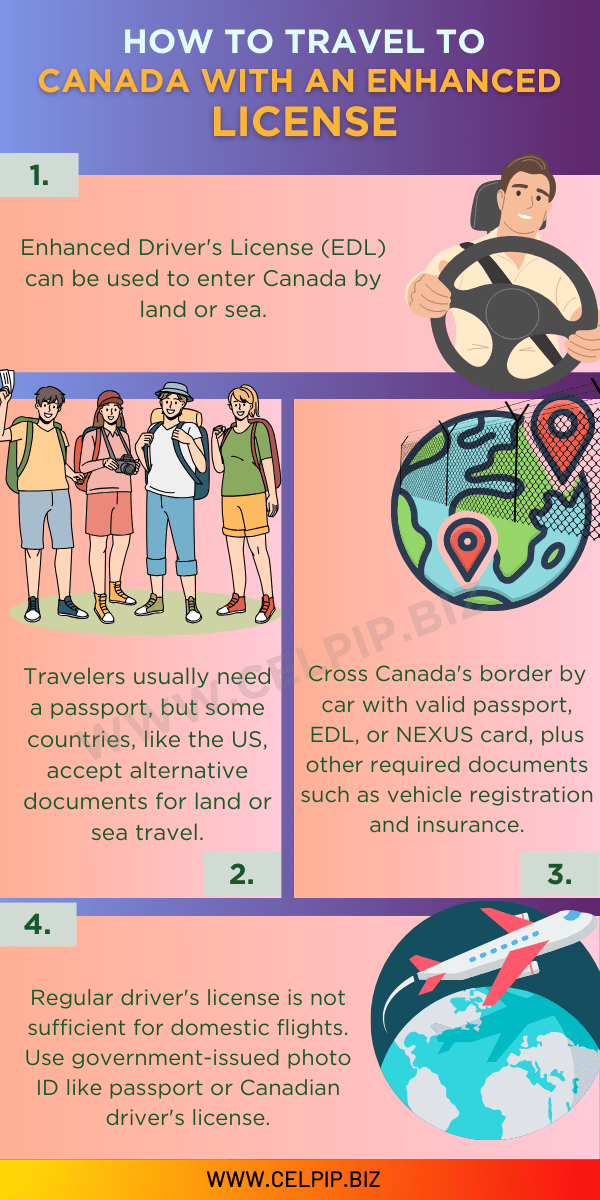
Yes. An Enhanced Driver’s License is valid for land and sea crossings into Canada.
Q2. Do I need a passport to visit Canada?
Most people do—but U.S. citizens can use an EDL instead for land/sea entry.
Q3. What do I need to drive across the Canadian border?
You typically need:
Valid passport, EDL, or NEXUS card
Vehicle registration
Vehicle insurance
Any additional documents requested by border officials