Navigating Canadian Work Permit: Canada is an ideal location for skilled workers looking to start their career in a foreign country. Canada is often referred to as the global job market for skilled immigrants. Canada is very welcoming to skilled immigrant workers who compensate for the skills shortages that are limiting its economic growth. This is why millions of skilled workers from all around the world apply to Canada as a destination each year.
To obtain a legal right to work in Canada, one needs a Canadian work permit, and the Refugees and Citizenship Canada (IRCC) system is how an applicant will navigate the system, especially with work permits. There are two kinds of Canadian Work permits – Employer-Specific Work Permits and Open Work Permits.
Choosing the correct pathway is essential for your Canadian Permanent Residency. There are different pathways for skilled workers with job offers and graduates who are applying for PGWP. Choose your pathway carefully. While Employer-Specific work permits provides stability, open work permits will give you flexibility.
Open Work Permit
This permit allows the skilled workers to work freely and flexibly. Individuals can work for any employer according to their skills. This gives them the opportunity to work freely without being tied to a single employer or a job. They can work at any company or at any location in Canada.
For those who want the freedom to explore a variety of career alternatives or switch employment without any issues, an open work permit is the best option.
According to IRCC guidelines, this permit does not restrict the work permit holder to a particular employer. However, there are some exceptions. The people who work in industries like striptease, erotic dance, escort services, or erotic massages are deemed ineligible for open work permits.
The typical duration of an Open work permit ranges from a few months to three years. In some cases, it depends upon the applicant’s circumstances, while in some cases it depends on the applicant’s passport validity.
As open work permits are not job-specific, Labour Market Impact Assessment (LMIA) are not required. This is helpful for many people and can simplify their visa process.
The most common example of an open work permit is spousal visas or common-law partner permits for international students or skilled workers. These work permits allow the spouse or the common-law partner to work for any employer in Canada while their partner can study or work in Canada.
Another example is the Post-Graduation Work Permit (PGWP). It allows the international graduates from designated learning institutions to gain Canadian work experience post-study. They can apply anywhere according to their qualifications to get the Canadian Work Experience.
For PGWP applicants, English proficiency is necessary. They can prove their English Language proficiency through tests like CELPIP and celpip.biz provides targeted preparation courses to help achieve the required scores.
Other individuals who can apply include temporary residents with a valid permit of six month. Protected people and refugees can also apply.
Additionally, eligible individuals also includes intra-company transferees under CUSMA. Open work permit holders have more independence and perform well in their fields.
Employer-Specific Canadian Work Permit
An employer-specific work permit, also known as a closed work permit, is in contrast to the open work permit. The employer-specific work permits restrict the individuals to work for a specific employer on a specific job, at a particular location, and for a defined period of time.
These conditions are listed on the work permit to ensure compliance with the regulations of IRCC. This permit is specifically designed for conditions where the Canadian employer is unable to find the local talent to fulfill the specific job requirements and can hire skilled immigrant workers for the job.
Labour Market Impact Assessment (LMIA) is an essential requirement for most employer-specific permits. It is issued by Employment and Social Development Canada (ESDC), which assesses the job offer’s impact on the domestic workforce.
However, there are exemptions for certain job roles, such as intra-company transfers, professionals under free trade agreements, or jobs in academia and research. The permit’s validity depends on the job offer, which is typically up to two years. There are extensions in some cases, depending upon the nature of the job.
The employer-specific work permit or closed work permit is mainly for skilled workers who apply under programs like the Temporary Foreign Worker Program (TFWP). For example, a software engineer who is offered a job position by a Toronto-based tech company will need an LMIA and an employment contract as proof to apply for the work permit by the tech company.
Language proficiency plays a crucial role in closed work permits. Many companies need employees who are fluent in English for effective communication. celpip.biz can assist you with CELPIP preparation to meet these language standards.
Employer-based permits are known for job security. The workers have stability but they can not change employer which limit their opportunities. If you are planning for a job change then you will need a new work permit. It can also cause instability in the stay of the workers.
Key Differences: A Comparison
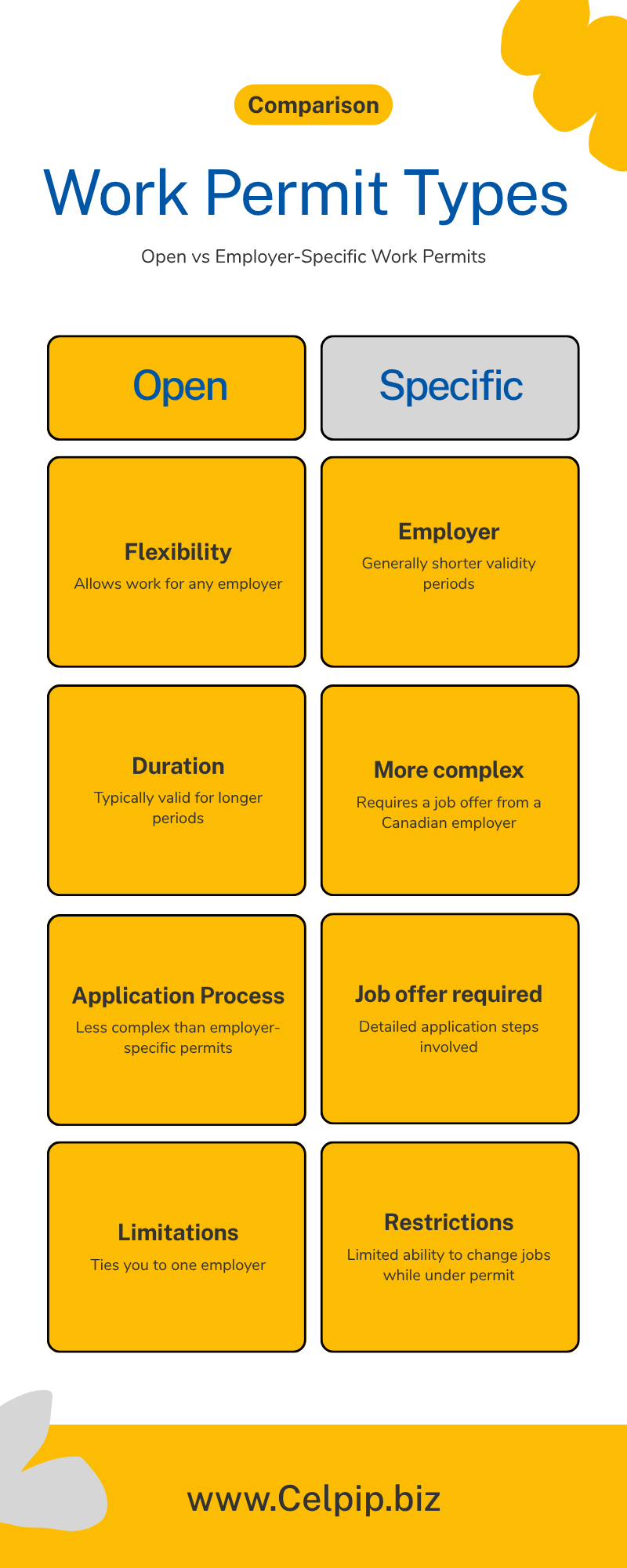
To clearly demonstrate the differences between open and employer-based work permits, the following lists all key points based on IRCC data.
| Aspect | Open Work Permit | Employer-Specific Work Permit |
| Employer Flexibility | Work for any eligible employer | Restricted to one specific employer |
| Job and Location | No restrictions (except ineligible industries) | Specific job, location, and duration listed |
| LMIA Requirement | Usually not required | Often required, unless exempt |
| Duration | Up to 3 years, based on eligibility | Tied to job offer, typically 1-2 years |
| Eligibility Focus | Spouses, graduates, refugees, etc. | Job offer with LMIA or exemption |
| Application Fee | $155 + $100 open holder fee | $155 (no additional holder fee) |
| Mobility | High—easy to switch jobs | Low—new permit needed for changes |
This table clearly shows the Job flexibility by open work permit and structured employment by Employer-Specific work permit. An open work permit holder can easily switch from one field to other without reapplying for work permit while employer-specific work permit holder risks the invalidation of their current permit if they want to switch the jobs or leaves their job prematurely. .
Eligibility Criteria for Each Permit
Meeting IRCC’s general criteria is the first step toward qualifying for work permits:
- Demonstrating an intention to depart Canada after the permit has expired,
- Having enough money to support themselves,
- A clean criminal record,
- Remain in good health, and
- Not represent a security risk to Canada.
The specifics of qualifications require consideration of the classification of work permit.
Open work permits: Many applicants for open work permit also fall under specified categories. The spouses/common law partners of full-time students or skilled workers under NOC 0, A or B are eligible for open work permit if the primary applicant is on a valid permit.
- To qualify, you must have completed a program of study at a DLI,
- applied for your PGWP within 180 days of being informed that you graduated (official letter confirming completion or transcript will suffice),
- and hold a valid study permit.
- Refugees and protected individuals are also eligible, as well as the individuals who are in waiting for their permanent residence decision.
Employer-Specific permits require a valid job offer with positive LMIA or exemption code. Employers are generally required to show recruitment requirements and also that they followed the minimum wage laws. Exceptions include the individuals such as charity workers or emergency repair workers.
How to Get a Work Permit in Canada (2025 Guide)
Getting a Canadian work permit may feel complicated at first, but when you follow a step-by-step process, it becomes much easier. Whether you are applying for an Open Work Permit or an Employer-Specific Work Permit, understanding the right pathway is the key to success.
This guide explains the full 2025 process clearly and practically.
How to Get an Open Work Permit in Canada
An open work permit allows you to work for almost any employer in Canada. It is not tied to a specific job or location, which makes it a popular option for spouses, graduates, and protected persons.
Step 1: Check Your Eligibility
Before applying, identify which type of open work permit you qualify for. Common categories include spouses or common-law partners of students or skilled workers, Post-Graduation Work Permit (PGWP) holders, and refugees or protected persons.
Choosing the correct category is important because each stream has different eligibility rules.
Step 2: Gather Required Documents
Once eligibility is confirmed, prepare your documents in advance. You will need a valid passport and proof of your current immigration status if applying from inside Canada.
Spouses must provide proof of relationship, while PGWP applicants need a completion letter or transcripts from their institution. All documents should be clear, readable, and uploaded in PDF or JPEG format.
Step 3: Create an IRCC Online Account
Visit the official IRCC website and create an online account if you do not already have one. This account will be used to submit your application, upload documents, and track updates.
Step 4: Complete the Online Application
Select the option for an Open Work Permit.
Applicants outside Canada must complete form IMM1295, while applicants inside Canada use IMM5710.
Fill in all required sections carefully and upload supporting documents before submitting.
Step 5: Pay the Application Fees
The standard fees include:
-
Work permit fee: CAD 155
-
Open work permit holder fee: CAD 100
-
Biometrics fee (if required): CAD 85
Payment is done online through the IRCC portal.
Step 6: Submit and Track Your Application
Submit your application through your IRCC account. You will receive updates by email or through the portal.
Processing usually takes 2 to 5 months, depending on your category and location.
Step 7: Receive Approval
If approved, applicants outside Canada receive a Letter of Introduction, which must be presented at the port of entry. Applicants inside Canada receive their work permit directly through their IRCC account.
How to Get an Employer-Specific (Closed) Work Permit
A closed work permit allows you to work for one specific employer, in one job role, at one location.
Step 1: Employer Completes Their Requirements
The employer must first obtain a Labour Market Impact Assessment (LMIA), if required. For LMIA-exempt jobs, the employer submits the job offer through the IRCC Employer Portal and receives a 7-digit offer number.
Step 2: Receive a Job Offer
You must have a written job offer or contract outlining your job title, duties, salary, and duration of employment.
Step 3: Prepare Your Documents
Required documents usually include a valid passport, LMIA or LMIA-exempt offer number, job offer letter, proof of qualifications, and work experience.
In some cases, you may also need police clearance certificates or medical exam results.
Step 4: Apply Through IRCC
Create or log in to your IRCC account and complete:
-
IMM1295 if applying from outside Canada
-
IMM5710 if applying from inside Canada
Upload all documents and review your application carefully.
Step 5: Pay the Fees
The employer-specific work permit fee is CAD 155.
Biometrics, if required, cost CAD 85.
Step 6: Submit Your Application
Applications are usually submitted online. Some visa-exempt nationals may apply at a Canadian port of entry, depending on IRCC rules.
Step 7: Processing and Approval
Processing times are typically 2 to 4 months. Certain streams, such as the Global Talent Stream, may be processed faster.
Approved applicants outside Canada receive a Letter of Introduction, while in-Canada applicants receive their permit through their IRCC account or by mail.
How a Work Permit Helps With Permanent Residency (PR)
Canadian work experience plays a major role in qualifying for permanent residency.
It increases your CRS score under Express Entry, improves eligibility for the Canadian Experience Class (CEC), and strengthens applications under Provincial Nominee Programs (PNPs).
PGWP holders, in particular, benefit from gaining Canadian experience in high-demand occupations.
Open Work Permit vs Employer-Specific Work Permit
An open work permit offers flexibility and freedom to change employers. It is ideal for people exploring different career options.
An employer-specific work permit provides stability and a clear employment pathway. It often supports stronger PR and PNP applications.
The right choice depends on your career goals, skills, and long-term plans.
Final Thoughts
Canada’s immigration rules change frequently, so staying informed is essential. Strong English or French language skills are crucial for both work permits and permanent residency.
For CELPIP preparation and language support, celpip.biz offers reliable tools to help you improve your scores and strengthen your application.
With the right documents, planning, and preparation, your goal of working and living in Canada in 2025 is absolutely achievable.