Getting a Canadian Work Permit is one of the best ways to build a career and improve your quality of life. If you plan to move to Canada as a skilled worker, student, or family member, it’s important to understand the difference between temporary work permits and permanent residency (PR).
A temporary work permit allows foreign nationals to work in Canada for a limited period. Permanent Residency, on the other hand, lets you live and work in Canada indefinitely and can eventually lead to Canadian citizenship.
This guide explains:
Temporary work permits
Open vs employer-specific permits
Permanent residency options
Express Entry pathways
Key immigration changes in 2023–2025
Importance of Language Skills
Most Canadian immigration pathways require strong English or French language skills. Language tests such as CELPIP are widely accepted and play a major role in both work permit and PR applications.
Using CELPIP practice tests can significantly improve your chances of success especially as immigration rules continue to tighten in 2025.
What Is a Temporary Work Permit?
Temporary work permits are issued by Immigration, Refugees and Citizenship Canada (IRCC). They allow foreign nationals to work in Canada for a specific period, usually when no qualified Canadian citizen or permanent resident is available.
Key Features of Temporary Work Permits
Valid for a limited time
Often renewable
Do not grant permanent resident status
Two Main Types
Open Work Permits
Employer-Specific (Closed) Work Permits
Open Work Permits
An open work permit allows you to work for almost any employer in Canada, with a few exceptions. There are no restrictions on job type or location.
Key Benefits
No LMIA required
Valid from a few months up to 3 years
Duration depends on passport validity and eligibility
Types of Open Work Permits
1. Spouse or Common-Law Partner Open Work Permit
For spouses of PGWP holders or skilled workers
2025 update: Only spouses of Master’s or PhD students are eligible
2. Post-Graduation Work Permit (PGWP)
For international graduates from eligible DLIs
Valid for up to 3 years
Must apply within 180 days of graduation
2025 changes: Limited to specific high-demand fields (e.g. hospitality, agriculture)
3. Bridging Open Work Permit (BOWP)
For applicants waiting for PR decisions
Maintains legal status during PR processing
Typically valid for 12 months or more
4. International Experience Canada (IEC)
For youth aged 18–35 from partner countries
Includes:
Working Holiday
Young Professionals
Co-op programs
Valid for 12–24 months
No LMIA required
5. Other Open Work Permits
For refugees, protected persons, and vulnerable workers
Temporary policy allows certain PNP candidates to stay until December 31, 2025
Employer-Specific (Closed) Work Permits
Closed work permits allow you to work only for:
One employer
One job role
One location
A specific time period
Most employer-specific permits require an LMIA, proving no Canadian worker is available.
Key Details
Usually valid up to 2 years
Renewable if job conditions remain the same
Types of Employer-Specific Work Permits
1. Temporary Foreign Worker Program (TFWP)
Used to fill labour shortages in:
Agriculture
Caregiving
Manufacturing
High-demand industries
Sub-streams include:
SAWP: Up to 8 months
Global Talent Stream: Fast processing (≈ 2 weeks) for tech roles
2. Intra-Company Transfers (ICT)
For executives, managers, and specialized workers
No LMIA required
Valid for up to 3 years
3. Caregiver Work Permits
For home child-care and home support workers
Eligible for PR after 2 years of Canadian work experience
Other LMIA-Exempt Categories
Researchers
Charity workers
Emergency repair workers
Fall 2025 policy: Some foreign workers can change employers without a new permit
What Is Permanent Residency (PR)?
Permanent Residency allows foreign nationals to:
Live, work, and study anywhere in Canada
Access most social benefits
Apply for citizenship after 3 years
Enjoy long-term stability and security
To manage housing and infrastructure pressures, Canada reduced its PR intake.
2025 PR target: 395,000 admissions
Express Entry: The Main PR Pathway
Express Entry is Canada’s primary system for skilled immigration. It uses a points-based ranking system known as CRS (Comprehensive Ranking System).
Express Entry Programs
1. Federal Skilled Worker Program (FSWP)
For skilled workers with foreign work experience
Minimum 67/100 points based on:
Age
Education
Language ability (CELPIP accepted)
Work experience
Adaptability
2. Canadian Experience Class (CEC)
For applicants with 1+ year of Canadian work experience
No education proof required
3. Federal Skilled Trades Program (FSTP)
For qualified tradespeople
Requires:
A valid job offer or
A certificate of qualification
How Express Entry Works
Create an online Express Entry profile
Receive a CRS score
Top candidates receive an Invitation to Apply (ITA) for PR
Provincial Nominee Programs (PNP’s)
Provinces nominate candidates to meet economic and labor market needs. Subtypes differ by province (for example, Ontario has human capital priorities program and Alberta has opportunity stream), and many PNP’s are linked to Express Entry (meaning that connections to the province, like work experience or a job offer, become very important).
Family Sponsorship
Eligible Canadian citizens and PRs can sponsor spouse or partner, children, parents or grandparents.
Subtypes include:
- Spousal (within or outside of Canada),
- Dependent Children,
- Parents/Grandparents (based on a lottery;
There will be no new visas beginning January 1, 2025). Sponsors must prove that they can support the applicant financially for a period of time while they settle into Canada.
Other Pathways
- Caregivers Program: This program is for individuals who have Canadian caregiving experience for minimum 2 years. This program has also subtype like Home Child Care Provider Pilot.
- Start-up Visa: This program is designed for entrepreneurs. Individuals who have innovative businesses ideas can apply under this program.
- Atlantic Immigration Program: This program is designed for Atlantic provinces; applicants requires job offers to apply under this program.
- Rural and Northern Immigration Pilot: This program is designed for rural areas. It is a Community-driven program for rural areas.
- Francophone Mobility: For the French-Speakers outside Quebec this program is designed.
Some new pathways for skilled refugees and displaced persons will be introduced in 2025 by Canadian immigration.
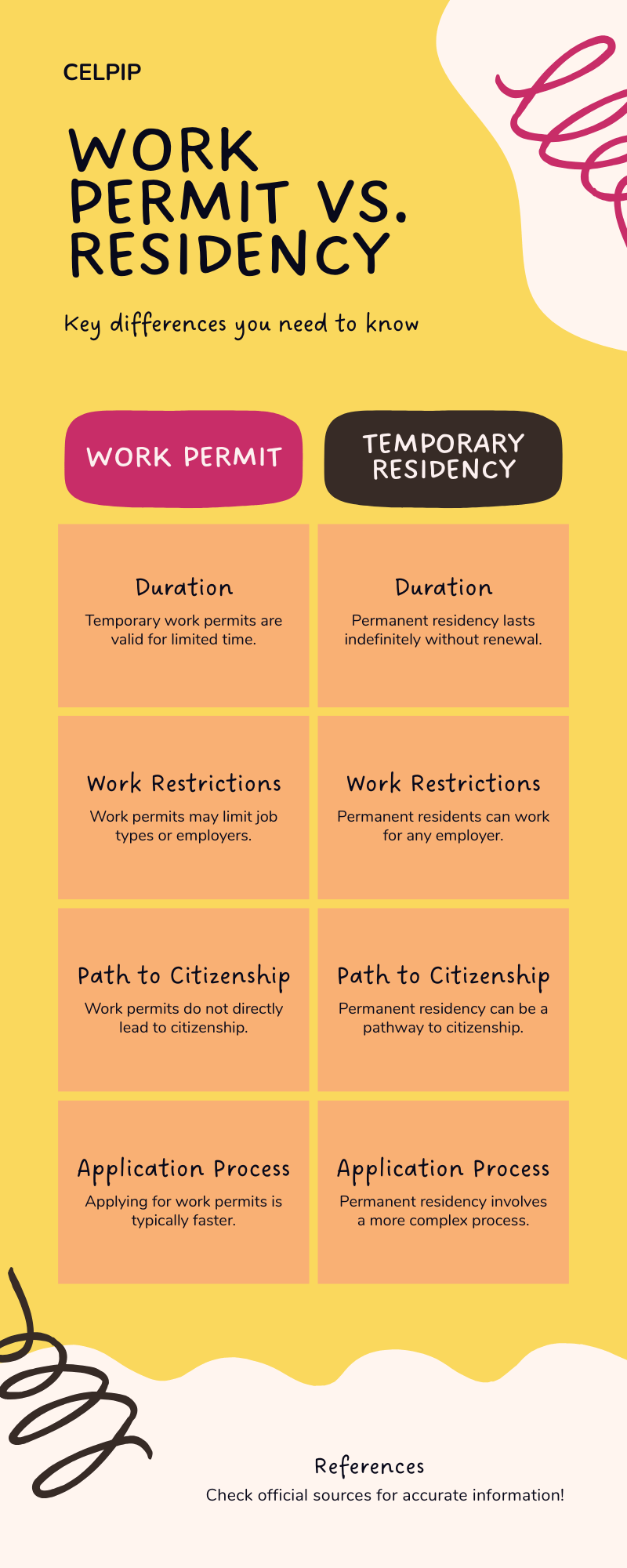
Key Differences:
Aspect | Temporary Work Permit | Permanent Residency |
Duration | Limited from few months to years; is renewable | Indefinite; renewable every 5 years |
Work Flexibility | Varies (open: any employer; specific: tied) | Any employer, anywhere |
Path to Citizenship | No direct; can lead via experience | Yes, after 3 years’ residency |
Family Inclusion | Limited (spousal permits possible) | Full sponsorship options |
Requirements | Job offer/LMIA often; temporary intent | Points-based/skills; settlement funds |
2025 Targets/Changes | New streams; eligibility tweaks | 395,000 admissions; reduced targets |
Processing Time | Weeks to months | 6-12 months or more |
Eligibility Criteria
For temporary permits: You must prove a temporary intent, funds, no criminality, health; these depend on your specific subtype (i.e. job offer would use the employer specific application).
For PR: It depends on your pathway; virtually all pathways consider language, education, experience, and settlement funds. Age is the only factor that is about adaptability (points systems) as well.
Application Process
For Temporary residency:
- Gather your documents (valid passport and job offer letter or LMIA)
- Either apply online or you can apply through VFS;
- Fees are about $155 plus biometrics are $85.
- Processing time can be 4-8 weeks.
For PR:
- For Express Entry, you create your profile on official IRCC portal,
- Receive an ITA,
- Prepare all your document proofs
- Submit your full application.
- Fees are approx. $1365 for adults.
- For other pathways, if sponsored, a sponsor will have to fill out form 1323/1324
- For nominee; a nominee will take an action towards getting additional points too.
Pros and Cons:
- If you need experience, Temporary permits are best. But if you need stability and other government benefits then Temporary permits are not suitable.
- PR is advantageous in stability, health care, and education access; however, it is disadvantageous to get and justify experience and higher qualifications- and you will have to wait longer.
Transition from Temporary to Permanent
Many people will temporarily permit (for example, a PGWP) to receive Canadian experience for CEC or PNP, and are using higher data for the your CEC score; while there might be a BOWP you can use to mitigate waiting for your permanent residency.
Temporary permits are fitting for short-term goals, more rigorous, settling your permanent residency is long term. Eventually something will change in Canada in 2025 policy framework that will place an emphasis on sustainability: take note on your decision.
If you are concerned about learning resources as a barrier, celpip.biz will have the tools to help you succeed. Celpip.biz is your central resource point for developing CELPIP confidence and access to opportunities in Canada.